What is a tea making machine, and how does it work?
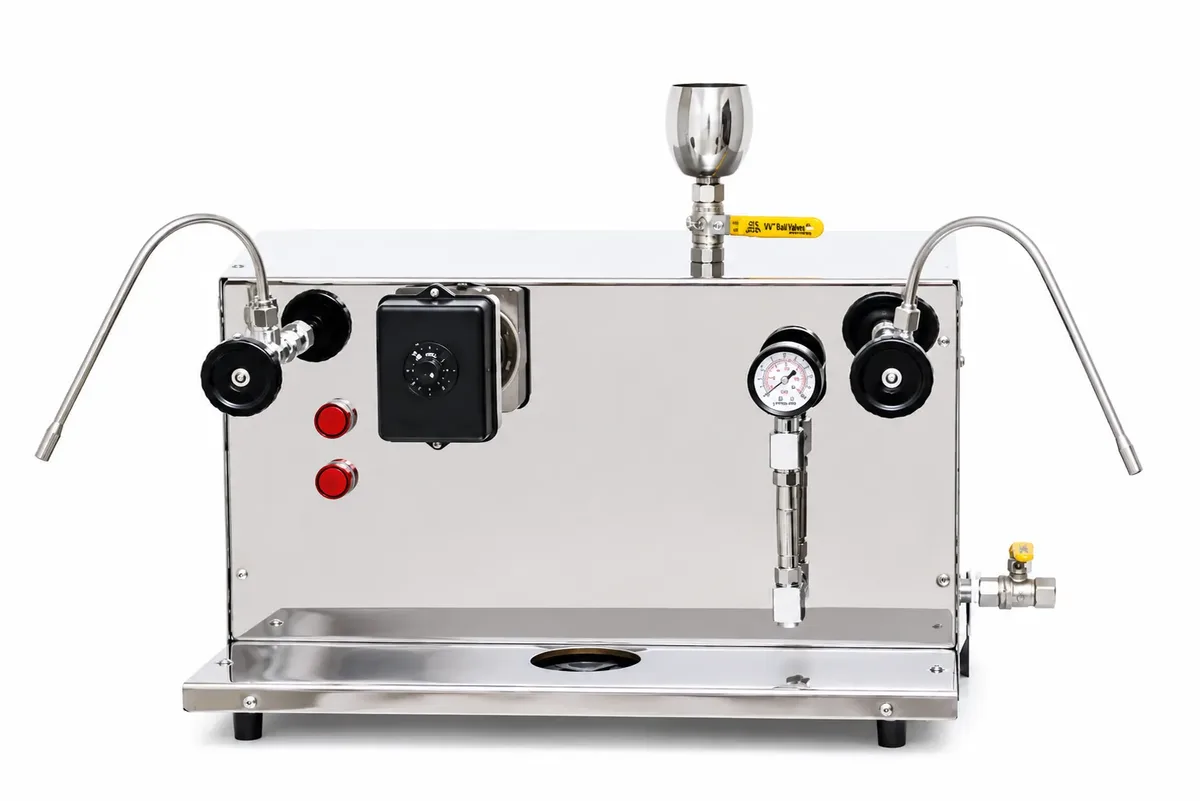
In Indian commercial use, a tea making machine means a steam machine: a stainless steel boiler heated by an electric element, fitted with a pressure gauge, a safety valve and two brass-fitted steam wands. Water in the sealed SS 304 tank is heated until it holds steam pressure. Open one wand into a jug of milk and the steam brings it to a rolling boil in the jug; open the other into a vessel of water and leaves for a rolling boil without a flame under it. A separate hot-water outlet handles green tea, black tea and plain hot water. The machine supplies heat and pressure on demand. The person behind the counter still decides how much sugar, how much adrak and how long the leaves steep.
Ask ten sellers for a machine for making tea and you will be shown at least three different things, so that description matters. The same words are used for two different products: steam machines like this one, and powder dispensers, which are not the same category and not the same monthly cost — a dispenser pushes hot water through a flavoured premix instead of boiling milk. A steam machine buys you speed while keeping your own recipe; a dispenser replaces the recipe altogether. If you are still weighing the two, the detailed comparison is in our fresh milk vs premix guide.
How is one cup of chai made on this machine?
There is no button that produces a finished cup. The sequence below is what a working shift looks like, start to finish.
- Switch on at the start of the day and let the boiler come up to pressure; the gauge on the front tells you when it is ready. After that it stays hot through the shift.
- Pour milk into a steaming jug. For one cutting chai that is about a cup and a half, and a jug of three or four cups steams in the same pass.
- Drop the first wand into the jug, open the valve, and hold the jug steady. The milk comes to a boil under the steam, which also lifts a light froth on top.
- Add tea leaves, sugar and crushed adrak or masala — or pour in strong decoction kept ready in a separate vessel, which is how busy counters keep up during a rush.
- Give it a few more moments of steam so the leaves release colour and the milk carries the flavour.
- Close the valve, strain into cups or kulhads, and wipe the wand with a damp cloth before the next jug.
Once the rhythm is set, each jug is steamed without waiting for a vessel to climb back to a boil. Because there are two wands, milk for coffee can be frothed on one while chai goes out on the other, and that parallel working is what keeps a mixed counter moving.
Which size fits your counter and your rush?
| Size | Price (ex-GST) | Cups per hour | Tank | Power | Suits |
|---|---|---|---|---|---|
| 17 inch Compact | ₹20,500 | ~200 | 8 L | 1500W | Stalls, kiosks, small shops |
| 23 inch Commercial | ₹23,500 | ~400 | 12 L | 1500W | Cafes, restaurants, office pantries |
| 29 inch Heavy Duty | ₹29,500 | ~700 | 18 L | 2000W | Canteens, hostels, caterers |
Size by your busiest 30 to 60 minutes, not by your daily total. A station kiosk that sells most of its chai in two sharp bursts needs more headroom than a cafe selling the same number of cups spread across twelve hours. Two other numbers decide the shortlist: counter width, since the 17 inch model needs about a foot and a half of it, and weight, which runs 18, 24 and 33 kg — worth checking if your counter is a folding one. The arithmetic behind the cups-per-hour figures is worked through in our cups per hour guide.
A tea making machine for commercial use also has to hold pressure through the rush rather than only on the first cup, which is why tank volume rises with size. If you are between two sizes, the larger one simply idles more of the day; the smaller one makes your customers wait at exactly the hour you earn the most.
What does it replace on your counter?
On a stall counter it takes the place of a gas bhatti with a large vessel of chai simmering on it. That vessel is the real problem: chai made at seven in the morning is still being sold at ten, and it tastes like it. With steam, each jug is made fresh when it is ordered, so nothing sits and stews, and the cylinder, the flame and the refill trips go with it. Running cost moves from gas to electricity — the two are compared side by side in our gas vs electric guide.
It also replaces the electric kettle setup that small offices use, where somebody boils water, adds a tea bag or powder and hopes for the best. It is not a like-for-like swap for a premix dispenser either: you keep buying milk, leaves and sugar instead of pouches, and you keep a person at the counter. What you get back is a cup that tastes like it was made by hand, because it was.
What does a tea making machine price include, and what does it cost to run?
The list prices above are ex-GST; 18% GST is added on the invoice under HSN 8419 81 20, and a registered business that is eligible to claim it can take that 18% back as input credit — worth confirming with your own accountant. The price includes the machine, both wands, the pressure gauge and safety valve, and the 5-year warranty against tank leakage. Transport is quoted separately because it depends on your city. There are no slabs, no dealer margin and no "call for price" — the same list applies everywhere in India, and it is published in full on the price page.
Running cost is arithmetic you can do with your own electricity bill rather than a number we invent. A 1500W element drawing power for one hour uses 1.5 units; a 2000W element uses 2. The element does not draw continuously — it cuts in to hold pressure — so take your commercial tariff per unit, multiply by the units above, and divide by the cups you serve in that hour to get a per-cup figure for your own shop. Milk, leaves and sugar remain your largest cost per cup by a wide margin, exactly as they are today. The method, with a worked example, is in our electricity cost per cup guide.
Who should not buy this machine
If you make ten or fifteen cups a day at home, this is the wrong purchase: it is a commercial machine built for a counter, and a gas stove will serve you better and cheaper. If you want a machine that delivers a finished cup at the push of a button with nobody standing there, this is not that machine — an operator is part of how it works. It is not an espresso machine either: if your menu is built on shots pulled from ground beans, this is the wrong category, because what the machine does is steam and froth milk for instant or decoction coffee. And if your counter has only a light-duty socket, budget for an electrician to run a dedicated point before delivery, because an electric tea maker machine of this size needs a supply that can carry 1500W to 2000W all day without the wiring warming up.
How to order and what happens next
Send your city and your rush-hour volume on WhatsApp and we will suggest a size honestly, including telling you when the smaller one is enough. Booking takes a ₹2,000 advance; the balance is paid when the machine reaches your city transport office. We dispatch within 24 to 48 hours, road transport takes 3 to 8 days depending on the city, and the machine travels in a wooden crate with transit damage covered — if it arrives broken, it is replaced. It reaches you ready to use: plug into the 230V point, fill the tank, and our team walks you through your first cups on a video call in Hindi or English. The daily and weekly cleaning routine, which is what keeps the tank warranty intact in hard-water areas, is set out in our maintenance guide.