Karmayogi Tea Coffee Machine

Tea Coffee Machine for Office Pantries and Canteens

₹20,500 to ₹29,500 + 18% GST · three sizes · delivered across India with a GST invoice

Fresh-milk chai and frothed-milk coffee from one pantry counter — sized by your headcount and your break, billed with a GST invoice your accounts team can claim.

Buying a tea coffee machine for office use is an approval problem as much as an equipment problem. Admin wants a cup nobody complains about, a per-cup number finance can defend, a machine the pantry person can run after one session, and an invoice accounts can process. This page does the sizing arithmetic out loud — headcount, break length and cups per hour — then covers the pantry electrical point, what a cup actually costs you, the GST paperwork, and the honest limits of a machine that still needs a human behind it.

Quick answer

A tea coffee machine for office pantries, in Indian commercial use, is a steam machine: an SS 304 boiler heated electrically until it holds pressure, feeding two brass-fitted steam wands and a hot-water outlet. Pantry staff steam fresh milk in a jug, add leaves, sugar and adrak, and strain the chai out; the second wand froths milk for instant or filter-decoction coffee. Nothing arrives in a sachet, so there is no supply contract behind the purchase. Three sizes cover office demand — 17, 23 and 29 inch, listed at ₹20,500 to ₹29,500 ex-GST, rated at roughly 200 to 700 cups an hour. All three run on one 230V single-phase point at 1500W to 2000W and carry a 5-year warranty against tank leakage. Invoices carry 18% GST under HSN 8419 81 20, which a registered company eligible to claim it can take as input credit.

By Karmayogi Tea Coffee Machine Team · Last updated

  • GST Invoice
  • Made in India
  • SS 304 Tank
  • 5 Year Tank Warranty
  • Pan-India Delivery

Why this machine

What You Get with This Office Tea Coffee Machine

  • Sized from your own headcount

    Pick the size from the number of people who take a cup in your busiest break, not from a daily total. The table below shows the arithmetic so you can change the assumptions to match your floor.

  • Fresh milk, no sachet contract

    Milk, leaves, sugar and coffee are bought at your own local rate from whoever you like. Nothing in the machine is locked to a supplier, so there is no annual renewal sitting behind it.

  • One 230V pantry point

    A 1500W to 2000W element on a single-phase point — no cylinder and no flame in the pantry. Confirm what your building permits and the rating of the point it will give a tea maker for office floors.

  • GST invoice and a 5-year tank warranty

    Every machine ships with an 18% GST invoice under HSN 8419 81 20 for your accounts team to assess for input credit, and a 5-year warranty against tank leakage on the SS 304 tank, in writing.

Sizes & prices

Three Sizes, One Steam Machine

Same build and warranty in every size — pick by your rush-hour volume.

17 Inch Compact

Tea stalls & small shops

₹20,500+ 18% GST

  • Up to 200 cups/hour
  • Electric only (2 steam wands)
  • 1500W · 8L tank · 18 kg
MOST POPULAR

23 Inch Commercial

Cafes, restaurants & canteens

₹23,500+ 18% GST

  • Up to 400 cups/hour
  • Electric only (2 steam wands)
  • 1500W · 12L tank · 24 kg

29 Inch Heavy Duty

High-volume outlets & caterers

₹29,500+ 18% GST

  • Up to 700 cups/hour
  • Electric only (2 steam wands)
  • 2000W · 18L tank · 33 kg
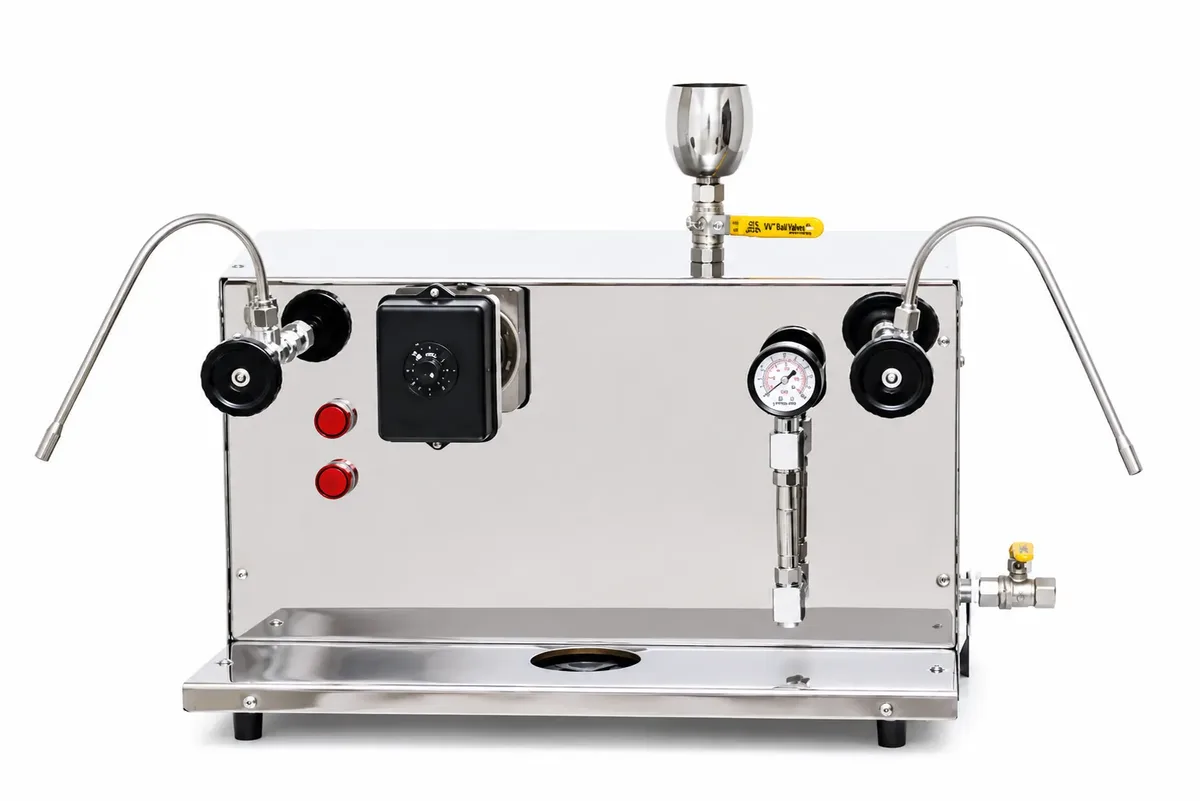
The 23 inch steam machine sized for an office pantry counter — twin steam wands for chai and coffee together, plus a hot-water outlet.
Body materialStainless steel, SS 304 tank
HeatingElectric heating element (no gas required)
Steam wands2 (milk frothing + hot water/tea)
SafetyPressure gauge, safety valve, water-level glass
Power supply230V single phase
Warranty5 years against tank leakage
Made inIndia
Ideal useFresh-milk chai, coffee, milk frothing, hot water

What does a tea coffee machine for office pantries actually do?

Inside the casing is a sealed SS 304 tank heated by an electric element until it holds steam pressure, with a gauge and a safety valve on the front, two brass-fitted steam wands and a separate hot-water outlet. The pantry person pours fresh milk into a jug, opens a wand, and the steam takes that jug to a rolling boil with no pan on a flame. Leaves, sugar and crushed adrak go in, a few more moments of steam follow, and the chai is strained into cups.

Twin wands matter more in an office than anywhere else, because a floor wants chai and coffee inside the same five minutes. One wand froths milk for instant or filter-decoction coffee while the other is working on chai, and the hot-water outlet covers green tea, black tea, lemon tea and whoever just wants hot water for a soup sachet — the whole pantry menu from one point on the wall.

It is worth saying plainly what it is not. This is not a premix or vending unit: nothing is dispensed from a powder cartridge and no sachet supply is tied to it. You keep buying milk and tea leaves at your own rate, and somebody keeps standing at the counter to make the cup. If you are still weighing the two categories against each other, that comparison is worked through in our office canteen buying guide.

How many cups does your office need in one break?

Size a tea machine for office use by your single busiest break — normally the one straight after lunch — not by the daily total. Two numbers settle it, and both belong to you rather than to us:

  • The share of your headcount that takes a cup in that break. Start at 3 in 5 and correct it from what your pantry already issues in a week.
  • How long the break actually runs. Use 30 minutes unless a shift bell makes it shorter.

Cups wanted in the break equals headcount multiplied by that share. A machine delivers its rated cups per hour pro rata, so a 30-minute break gets you half the hourly figure and a 20-minute break roughly a third. Then plan on filling about 70% of that pro-rata figure rather than all of it, because one pantry person and not the boiler is what limits a break. Put the three steps together and the bands below fall out.

HeadcountCups wanted in a 30-min break (3 in 5)SizeCups per hourPrice (ex-GST)
Up to 115up to ~7017 inch~200₹20,500
115 to 230~70 to 14023 inch~400₹23,500
230 to 400~140 to 24029 inch~700₹29,500
Above 400240 and upTwo machines, or stagger the breaks——

Change an assumption and the bands move with it. If only 2 in 5 of your people take a cup, multiply each headcount band by 1.5. If a factory shift bell compresses the break into 20 minutes, cut the bands to about two-thirds — a shift break is the one office pattern that pushes a mid-size floor up to the 29 inch machine. Heavier round-the-clock use, such as a hospital or hostel canteen, is covered on our commercial tea machine page.

Who operates a tea and coffee machine for office use?

A person does. An office coffee and tea machine of this kind is a tool for your pantry staff, not a replacement for them. There is no button that hands a finished cup to an employee walking past, and it is not designed for self-service by a floor of people: steam wands and untrained hands are a bad mix.

What the pantry person learns, in one setup call on video in Hindi or English:

  1. Switching on at the start of the day and letting the boiler reach pressure, then leaving it on through the shift.
  2. Steaming a jug of three or four cups in one pass instead of one cup at a time.
  3. Keeping strong decoction ready in a separate vessel before a known rush.
  4. Wiping each wand with a damp cloth after every jug, before milk dries on the nozzle.
  5. Purging a short blast of steam through both wands at closing, and draining the tank weekly.

Get that person onto the setup call, not only the admin who signed the order. The daily routine is about five minutes; the job that cannot be skipped is descaling on schedule in hard-water areas, because scale damage from skipped descaling is not covered by the tank warranty.

What does the pantry point and the counter need?

Electrically it is one 230V single-phase point: 1500W for the 17 and 23 inch machines, 2000W for the 29 inch. Before delivery, have your facilities electrician confirm that the point, the wiring behind it and the MCB on that circuit can carry the rated load continuously, and ask for a dedicated 16A point rather than sharing a strip with the microwave and water cooler. Earthing matters here: it is a steel body handled with wet hands all day.

Physically, plan for width and weight: the three sizes are 17, 23 and 29 inch across and weigh 18, 24 and 33 kg, so a fixed pantry counter is fine and a folding table is not. Keep the tank fill point reachable: water goes in manually, not from a plumbed line.

What will a cup cost, and what will accounts ask for?

Per-cup cost here is ingredients plus a little electricity, which you can work out from your own rates rather than take on trust. Add your milk, tea, sugar and coffee cost for one cup; then for electricity, note that a 1500W element drawing power for an hour uses 1.5 units and a 2000W element uses 2, though the element cuts in and out to hold pressure rather than drawing flat out. Multiply by your commercial tariff and divide by the cups served in that hour. If you run a powder-dispenser contract today, put its cost per cup next to that total — the difference is that milk and leaf prices are set by your market, not by one vendor.

Any coffee and tea machine for office price you compare should be read alongside three things: tank steel grade, rated wattage, and how long the tank is warranted against leakage. Our list is published in full on the price page, ex-GST, the same across India. Accounts get an 18% GST invoice under HSN 8419 81 20, which a registered company eligible to claim it can take as input credit — the classification detail is in our GST and HSN guide.

Who should not buy this pantry machine

If your pantry has nobody staffing it — a floor where employees help themselves between meetings — do not buy this machine; you want a premix dispenser instead of a steam machine, and we would rather lose the order than leave a steam wand unattended. If you are looking at a tea coffee machine for small office use, say twelve people and thirty cups a day, a kettle and a good tea bag will cost you far less than a commercial boiler that idles for seven hours. If your menu needs espresso shots rather than frothed milk, this is the wrong equipment category — the machine steams and froths, it does not grind. And if your leased pantry has only a light-duty socket and the landlord will not allow a new point, settle that before ordering rather than on delivery day.

How to order, and what happens on delivery day

Send us your headcount, break length and city on WhatsApp and we will size it with you, including telling you when the smaller machine is enough. A tea making machine for office use is booked with a ₹2,000 advance; the balance is paid when the machine reaches your city transport office, and the transport charge depends on the city and is confirmed on WhatsApp before you pay anything. We dispatch from our Ahmedabad unit in 24 to 48 hours, road transport takes 3 to 8 days, and the machine travels in a wooden crate with transit damage replaced. Keep the pantry person free on the day after arrival for the setup video call, and the first tray of chai goes out that morning.

How Ordering Works

  1. 1

    Enquire

    WhatsApp or call us with your city and business type. Get final price with transport quote.

  2. 2

    Book with ₹2,000

    Pay a small advance by UPI or bank transfer to confirm your machine.

  3. 3

    Secure dispatch

    Machine packed in a wooden crate, dispatched by road transport with bilty tracking.

  4. 4

    Balance on delivery

    Pay the remaining amount when the machine reaches your city. GST invoice included.

Office Tea Coffee Machine FAQs

Is this a premix vending machine for offices?

No. It is not a premix or vending machine, and we would rather clear that up before you raise a purchase order. Nothing is dispensed from a powder sachet and there is no cartridge supply tied to the machine — your pantry staff steam fresh milk in a jug, add leaves, sugar and masala, and strain the cup out. What the machine replaces is the heat source and the waiting, not the person. If your requirement is genuinely a self-service unit that an employee operates with one button and no staff on duty, this is the wrong product and you should buy that instead.

Can employees serve themselves from it?

It is not built for that. The steam wands are hot, they are opened by a valve, and milk has to be poured into a jug and held steady while it boils — none of which suits a queue of people who have never used the machine. Run it as a counter service instead: one pantry person makes the cups and hands them over. If your building has no pantry staff at all on some shifts, plan for the machine to be switched off during those hours rather than left open to the floor.

What electrical point does an office pantry need for it?

A tea coffee maker machine for office use needs a 230V single-phase point with proper earthing, rated for the size you buy: 1500W for the 17 and 23 inch machines and 2000W for the 29 inch. That is the same order of load as a pantry geyser. Ask your facilities electrician to confirm the point, the wiring and the MCB can carry it continuously, and to give you a dedicated point instead of a shared extension strip. There is no gas connection and no flue involved; what your building permits is still its own rule, so ask facilities for the permitted-equipment list before you order.

We are a forty-person office — is there a tea coffee machine for small office use?

The 17 inch machine at ₹20,500 is the smallest we make, rated at about 200 cups an hour, and at forty people it will be idle most of the day. That is fine if you want real chai on tap and have a pantry person already on the payroll. If neither is true, be honest with yourself about the maths: a commercial boiler bought for thirty cups a day is an expensive way to avoid a kettle. The size starts to earn its keep when a single break asks for fifty or more cups back to back.

Does it cost less per cup than our sachet contract?

That depends on numbers only you have, so here is the method rather than a claim. Take your current cost per cup from the sachet contract. Against it, put your own milk, tea, sugar and coffee cost for one cup, plus electricity — a 1500W element running for an hour uses 1.5 units, so multiply by your commercial tariff and divide by the cups made in that hour. The structural difference is that ingredient prices are set by your local market and can be renegotiated any month, while a sachet rate is set by whoever supplies the machine.

What does the warranty cover, and what happens if something fails?

The SS 304 tank carries a five-year leakage warranty, which is the clause worth checking with any seller because the tank is the part that holds the pressure. For everything else, faults are diagnosed on a WhatsApp video call in Hindi or English and spares such as the element, gasket, wand nozzle, gauge or valve are couriered from Ahmedabad within 48 hours, for the life of the machine. What the tank warranty does not cover: drops and physical damage, running the tank dry, unauthorised modification, and scale from skipped descaling. In hard-water pantries the descaling schedule is what keeps the tank warranty intact, so put it on the housekeeping checklist.

Can we get a GST invoice for the purchase order?

Yes. Every machine ships with a GST invoice from our Ahmedabad unit — 18% on the listed ex-GST price, under HSN 8419 81 20 — and a GST-registered company eligible to claim it can take that tax as input credit, which is a question for your accounts team rather than for us. Give us your company name, address and GSTIN at booking so the invoice is raised correctly the first time, because amending it afterwards is slower than getting it right. We sell direct, with no dealer or showroom in between, so the invoice comes from the people who built the machine.

How long does delivery and setup take for an office?

Dispatch is within 24 to 48 hours of the booking advance, and road transport takes 3 to 8 days depending on your city; we confirm the transport charge on WhatsApp before any payment. The machine arrives at your city transport office in a wooden crate, where the balance is paid, and transit damage is replaced. Setup is not an engineer visit: place it on the pantry counter, plug into the 230V point, fill the tank, and we walk your pantry person through the first cups on a video call. Book the call for a morning when that person is actually on duty.

Get Your Best Price for a Office Tea Coffee Machine

We reply within working hours, usually in minutes. No spam.

Other machine types

  • Tea Making Machine

    A steam tea making machine that boils and froths fresh milk on your counter — 200 to 700 cups an hour from a single 230V point, with no gas cylinder in the shop.

  • Chai Machine

    Steam wali chai machine jo aapke counter par asli doodh bina kisi intezaar ke ubaal deti hai — 200 se 700 cup ghante ke, ek 230V point par, dukan mein bina cylinder rakhe.

  • Tea and Coffee Machine

    One boiler, two steam wands and a hot-water outlet — chai on one wand, frothed milk for coffee on the other, green tea from the tap, all from a single 230V point.

  • Coffee Steamer Machine

    A coffee steamer machine built around two brass-fitted wands: drop one into a jug and dry steam heats and froths fresh milk with no pan on a flame, on a single 230V point.

  • Electric Tea Machine

    An electric tea machine that works off a single 230V point — nothing to book, nothing to carry upstairs, and a fuel cost you can calculate from your last electricity bill before you buy.

  • Tea Machine for Shop

    Seventeen inches of counter, one 230V point, and every cup steamed to order — the compact size is built for a chai ki dukan where the counter is the whole shop.

  • Commercial Tea Machine

    Built for institutional duty: an 18 litre SS 304 pressure tank, twin brass-fitted steam wands and a 2000W element that keeps pouring through a shift break — about 700 cups an hour from one 230V point.

Compare every size and price in one table →