What is a coffee steamer machine, and what does the wand actually do?
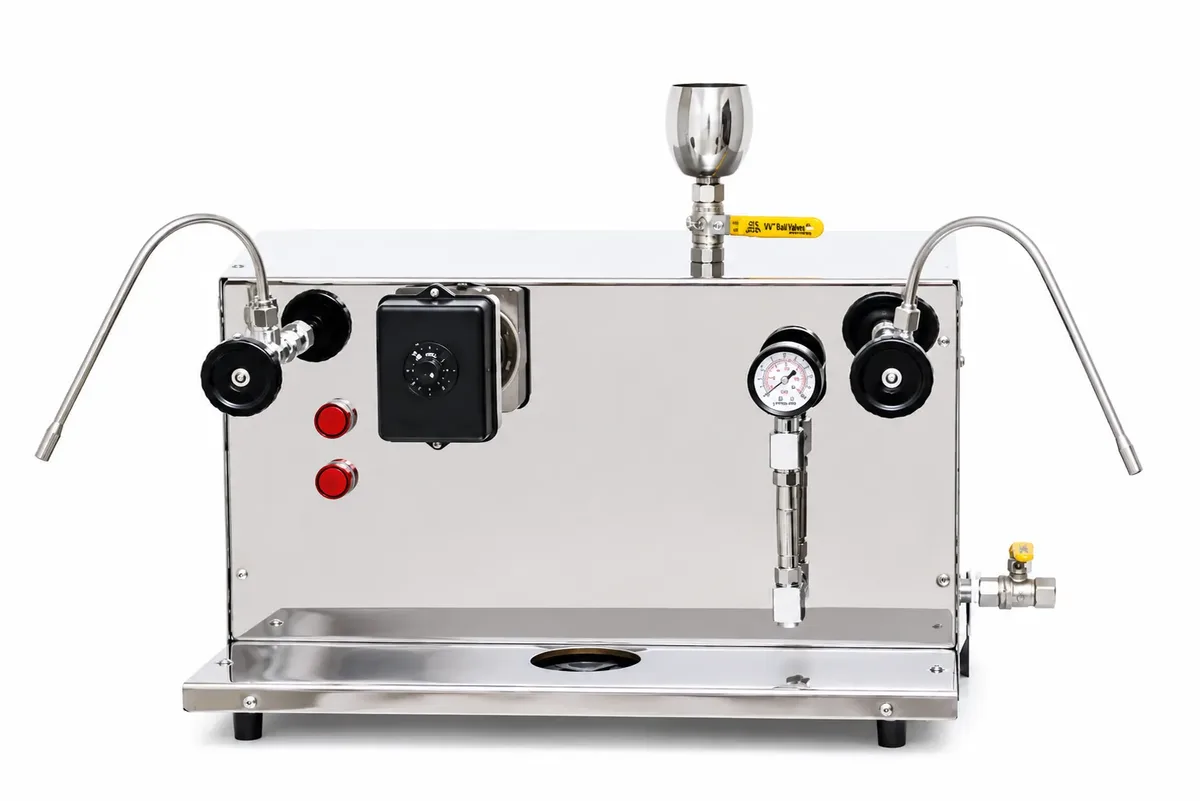
Strip the cabinet away and the machine is simple. An SS 304 tank holds water, an electric heating element brings it up until the sealed tank is holding steam pressure, and a gauge on the front shows you that pressure while a safety valve protects the tank. Two brass-fitted wands tap that pressure. Open the valve on one, with its nozzle sitting under the surface of cold milk, and dry steam rushes in — it transfers heat straight into the liquid rather than through the metal of a pan, which is why a jug comes up without waiting for a pan to heat.
Two things happen at once, and that is the whole point of a steam coffee machine. The milk gets hot, and the nozzle drags air down into it, breaking the fat into a fine foam. A pan on a burner can do the first job. Only a coffee machine with steamer attached does the second.
There are two of them because a counter that sells coffee also sells chai and hot milk, and the separate hot-water outlet handles black coffee, green tea or topping up a decoction flask.
How do you froth milk on the wand, step by step?
There is no dial that produces microfoam by itself. The texture comes from where you hold the jug, and the sequence below is the whole technique.
- Switch on at the start of the shift and wait for the gauge to show working pressure. Once it is there the machine holds it all day, cutting in and out on its own.
- Purge a short blast of steam into an empty vessel first. That clears the condensed water sitting in the wand so it does not thin out your milk.
- Fill a steel jug about one-third with cold milk. Cold milk gives you a longer window to work the foam before the jug gets too hot to hold.
- Put the nozzle in just below the surface, hold the jug at a slight tilt, and open the valve fully. A half-open valve gives you wet, bubbly foam.
- Listen for a soft hissing tear for the first three or four seconds — that is air going in. Then sink the nozzle deeper so the milk spins in the jug and the big bubbles break down.
- Close the valve as soon as the outside of the jug is too hot to keep your palm on comfortably. Steam past that point scalds the milk and the foam collapses.
- Knock the jug once on the counter, swirl it, and pour. Wipe the wand immediately with a damp cloth and purge it again.
Used this way it is a milk steamer machine first and a coffee machine second: the steam does the heating and the aeration in one action, and a jug of three or four cups is finished without waiting for a pan to reach a simmer.
Which coffee drinks can you honestly make on it?
Here is the honest list, because a coffee machine with frother is sold under a lot of loose descriptions. You can make instant coffee with steamed frothy milk, where granules are dissolved in a little hot water from the outlet and the frothed milk goes on top. You can make South Indian filter coffee by steaming milk and adding your own decoction, which is the fastest route to a good cup on this machine. You can serve cappuccino-style coffee — strong coffee under a thick head of steam foam — and cold-weather items like hot chocolate, badam milk and plain hot milk come off the same wand.
What it does not do matters just as much. It has no grinder, so it will not grind beans. It has no group head and no portafilter, so it will not pull espresso shots from ground coffee. A coffee frother machine at this price is a steam source plus a milk technique, not a bean-to-cup unit. If your menu is built on shots, this is the wrong category, and we will say so on WhatsApp rather than after delivery. If it is built on milk-forward coffee and chai together, look at the same machine framed as a tea and coffee machine.
Which size is right for a coffee counter?
| Size | Price (ex-GST) | Cups per hour | Tank | Power | Counter it suits |
|---|---|---|---|---|---|
| 17 inch Compact | ₹20,500 | ~200 | 8 L | 1500W | Kiosks, takeaway windows, small coffee corners |
| 23 inch Commercial | ₹23,500 | ~400 | 12 L | 1500W | Cafes, bakeries, restaurant service counters |
| 29 inch Heavy Duty | ₹29,500 | ~700 | 18 L | 2000W | Canteens, hostels, banquet and catering counters |
The 23 inch is the one we point coffee counters towards first: the 12 L tank holds enough steam to work two jugs back to back without the gauge dropping, while still leaving counter room for cups and a decoction flask. Weights run 18, 24 and 33 kg, so check that the counter under it is fixed rather than folding.
Pick the steamer machine for coffee that matches your sharpest half hour, not your day total. A bakery selling forty coffees between five and six needs more stored steam than a pantry spreading the same forty across a morning. Between two sizes, the larger one only costs you idle time; the smaller one costs you the queue.
How do you clean the steam wands?
Milk is the enemy of a steam nozzle. Dried milk narrows the holes, the froth gets weak, and the fix is a routine rather than a monthly deep clean.
- Wipe each wand with a damp cloth the moment the jug is poured, while the metal is still hot and the milk has not set.
- Purge a one-second blast of steam after every wipe to clear milk that was sucked back into the nozzle.
- At closing, soak both nozzle tips in a jug of hot water for a few minutes, then purge each wand again.
- Once a week, check the nozzle holes against the light and clear any blocked hole with a pin.
- Drain and rinse the tank weekly, and descale on schedule if your water is hard — scale damage from skipped descaling is not covered by the tank warranty.
The whole daily routine is about five minutes across both wands. The full schedule, including what to use for descaling, is set out in our maintenance guide.
Who should not buy this steam machine
If you need a machine that finishes a cup with nobody standing at it, skip this one — an operator holds the jug, judges the texture and pours, and that is not a step we can remove. If you roast or grind your own beans and sell shot-based drinks, this is not the equipment for that menu. If you make twenty cups a day at home, a commercial steam boiler is more machine than the job needs and a small stovetop setup will serve you better. And if the only socket near your counter is a light-duty one shared with lights and a fridge, get an electrician to confirm the point, the wiring and the MCB can carry 1500W to 2000W continuously, and to run a dedicated earthed point before the machine is delivered.
What it costs, and what happens after you book
Prices are published in full on the price page — the same list applies in every city, with no dealer margin, because the machines are sold direct from Ahmedabad and there are no showrooms in between. The figure is ex-GST; 18% is added on the invoice under HSN 8419 81 20, which a registered business eligible to claim it can take as input credit — confirm your own eligibility with your accountant. Transport depends on your city and is confirmed on WhatsApp before you pay anything. To book, send your city and your busiest hour's coffee count, pay a ₹2,000 advance, and settle the balance when the machine reaches your city transport office. Dispatch is within 24 to 48 hours, road transit runs 3 to 8 days, and the machine travels in a wooden crate with transit damage replaced. Setup and your first frothing attempts are walked through on a video call in Hindi or English. If you are still deciding between fresh milk and a powder-based setup, read our comparison guide first.