Karmayogi Tea Coffee Machine

Electric Tea Machine for Shops, Offices and Food Courts

₹20,500 to ₹29,500 + 18% GST · three sizes · delivered across India with a GST invoice

An electric tea machine that works off a single 230V point — nothing to book, nothing to carry upstairs, and a fuel cost you can calculate from your last electricity bill before you buy.

Switching from a bhatti to an electric tea machine changes three things on day one. Your fuel becomes a meter reading instead of a cylinder booking. Your counter loses its open flame, which is what makes the machine workable in buildings that will not allow one. And your running cost turns into arithmetic you can do in advance instead of a number somebody quotes you. This page hands you that arithmetic with your own tariff left as the variable, the wiring points to put in front of an electrician, and a straight account of where electric-only is a disadvantage.

Quick answer

An electric tea machine is a steam chai machine whose heat comes from a resistance element sealed inside a stainless steel water tank, so the only supply it needs is a 230V single-phase point — there is no burner and nothing combusting under the vessel. Ours is built in 17, 23 and 29 inch sizes, listed at ₹20,500 to ₹29,500 ex-GST. The 17 and 23 inch are rated 1500W and the 29 inch 2000W, which at full draw works out to 1.5 and 2 units of electricity an hour. Treat those as ceilings: once the tank is up to pressure the element cycles on and off to hold it rather than drawing flat out. Inside is an SS 304 tank of 8, 12 or 18 litres feeding two brass-fitted steam wands, a pressure gauge, a safety valve and a hot-water outlet. The SS 304 tank carries a five-year warranty against leakage.

By Karmayogi Tea Coffee Machine Team · Last updated

  • GST Invoice
  • Made in India
  • SS 304 Tank
  • 5 Year Tank Warranty
  • Pan-India Delivery

Why this machine

What You Get with This Electric Tea Machine

  • One 230V point, nothing else

    A 1500W element in the 17 and 23 inch sizes, 2000W in the 29 inch. No cylinder to book, no storage space for one, no empty going dry halfway through a rush.

  • Running cost you calculate yourself

    Units per hour = watts divided by 1000. Multiply by the per-unit rate on your own bill and divide by the cups you serve in that hour. No national average, no guesswork.

  • No flame on the counter

    Nothing burns and there is no cylinder to store or refill. Where flames or cylinders are restricted, ask the property for its permitted-equipment list and the rating of the point it will give you.

  • A commercial electric tea maker, not a home one

    SS 304 tank, twin brass-fitted steam wands, 18 to 33 kg of machine built to hold pressure through a rush, with a 5-year warranty against tank leakage.

Sizes & prices

Three Sizes, One Steam Machine

Same build and warranty in every size — pick by your rush-hour volume.

17 Inch Compact

Tea stalls & small shops

₹20,500+ 18% GST

  • Up to 200 cups/hour
  • Electric only (2 steam wands)
  • 1500W · 8L tank · 18 kg
MOST POPULAR

23 Inch Commercial

Cafes, restaurants & canteens

₹23,500+ 18% GST

  • Up to 400 cups/hour
  • Electric only (2 steam wands)
  • 1500W · 12L tank · 24 kg

29 Inch Heavy Duty

High-volume outlets & caterers

₹29,500+ 18% GST

  • Up to 700 cups/hour
  • Electric only (2 steam wands)
  • 2000W · 18L tank · 33 kg
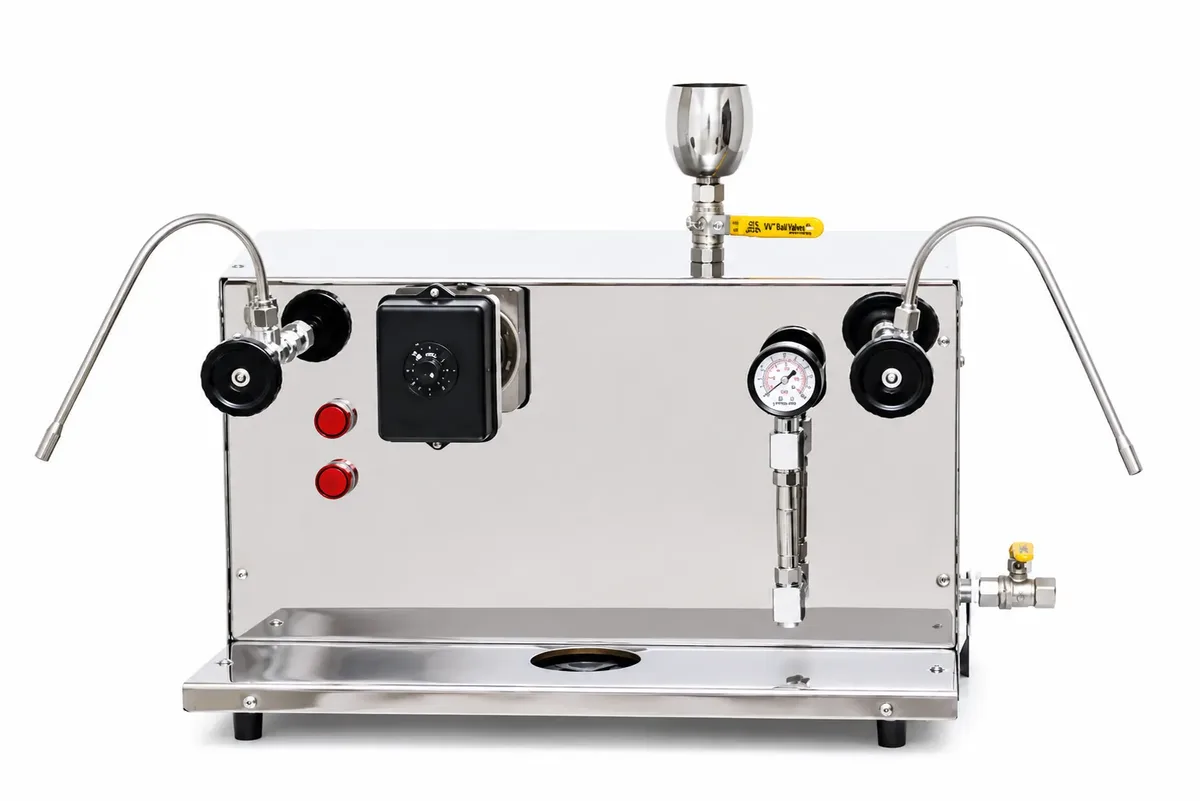
The 17 inch electric tea machine on a counter — one 230V lead, a pressure gauge and twin steam wands, with no cylinder behind it.
Body materialStainless steel, SS 304 tank
HeatingElectric heating element (no gas required)
Steam wands2 (milk frothing + hot water/tea)
SafetyPressure gauge, safety valve, water-level glass
Power supply230V single phase
Warranty5 years against tank leakage
Made inIndia
Ideal useFresh-milk chai, coffee, milk frothing, hot water

What makes an electric tea machine different from a gas bhatti?

The brewing end is the part you already know: steam into a jug, milk, leaves, sugar, adrak. What changes is where the heat is generated. On a bhatti a flame heats whatever vessel sits above it. Here a resistance element sits inside a sealed SS 304 tank and heats the water in it until the tank holds steam pressure, and that pressure is what you release through either brass-fitted wand. The gauge on the front shows you where the pressure is, a safety valve caps it, and a separate hot-water outlet draws plain hot water for green tea, black tea or for rinsing a jug between drinks.

Four practical things follow from the heat being electric. Nothing has to be booked, delivered or carried: an electric chai machine has no cylinder behind it and needs no floor space set aside for a spare. Nothing is burning, so there is no flame in front of the person working the counter and no fuel stored under it. Heat is available the moment the tank is at pressure and stops the moment you close the valve. And the fuel shows up as one line on a bill you already receive every month, which is why the cost section below is arithmetic rather than an estimate. The honest cost of all this is that when the power goes, the machine goes with it — that trade is worked through in our gas versus electric comparison.

How much electricity does an electric tea machine use?

Start with the rating, because the rating is the ceiling. Units per hour = watts ÷ 1000. A 1500W element therefore cannot use more than 1.5 units in an hour and a 2000W element cannot use more than 2, no matter how hard the counter is working. Your cost for that hour is those units multiplied by the per-unit rate printed on your own electricity bill.

SizeRated powerUnits per hour at full drawCost per hour
17 inch1500W1.5 units1.5 × your rate per unit
23 inch1500W1.5 units1.5 × your rate per unit
29 inch2000W2 units2 × your rate per unit

Use your own rate and nobody else's. Tariffs differ by state, by board and by whether your meter is commercial or domestic, so a figure copied off a website is not your figure. Fill in the right row above from your last bill and you have the ceiling for an hour of brewing. Divide that by the cups you actually serve in that hour to get a per-cup ceiling, then set it beside what the same hour costs you in milk, leaves and sugar — that comparison is the one that tells you whether electricity deserves any weight in the decision at all.

Two adjustments make the real figure lower than the ceiling. The element draws full power while it brings a cold tank up to pressure, then cuts in and out to maintain it, so a slack afternoon costs far less per hour than the table shows. And it only draws while switched on, which for a stall trading in two bursts is not the same as its opening hours. The worked method, with the duty cycle explained properly, is in our electricity cost per cup guide.

What should an electrician confirm before delivery?

We make no promises about wiring we have not seen, so treat the list below as questions for a licensed electrician. Get them checked before the machine arrives, not on the morning you want to start selling.

  • A dedicated 230V single-phase point for the machine alone, not a socket already shared with the fridge, the grinder, the fans and the lights.
  • Cable sized for a continuous load — 1500W for the 17 and 23 inch, 2000W for the 29 inch — over the actual length of the run from your meter to the counter, not just at the socket end.
  • An MCB rated for that line, so a fault trips one breaker instead of darkening the whole shop.
  • Earthing that has been tested, not assumed. This is a steel-bodied machine handled with wet hands next to steam all day, and earthing is the part you do not compromise on.
  • A properly rated socket and plug top, fixed to the wall. A loose extension board carrying a 1500W load for twelve hours a day is the wrong place to save money.
  • Where the point sits: above splash height, behind the counter, and within reach so the machine can be switched off without crawling under anything.

Where the answer on any of them is no, that work is part of the cost of the machine and belongs in your budget alongside the price page figures.

Where does having no cylinder actually matter?

In some buildings it decides whether you can trade at all. Some premises — a mall food court, a corporate campus, a hospital block, a hostel, an airport terminal, a leased commercial unit — do not permit open flames or cylinders; that rule is set by the building or the licensor rather than by you, and it varies from one address to the next. An electric tea maker machine sidesteps the question entirely: it needs a socket, which is already there. Rather than take our word for the rules that apply to you, ask your building management for their permitted-equipment list in writing before you sign a counter agreement.

It matters in smaller ways too. An office pantry has nobody whose job it is to notice a cylinder is running low, which is exactly why a plug-in machine suits that setting; sizing one against headcount is covered on our office tea coffee machine page. A compact market stall may have no safe place to store a spare cylinder at all. And on an upper floor, every refill is a staircase.

Which size and which wattage should you pick?

SizeElectric tea machine price (ex-GST)PowerTankCups per hourWeight
17 inch Compact₹20,5001500W8 L~20018 kg
23 inch Commercial₹23,5001500W12 L~40024 kg
29 inch Heavy Duty₹29,5002000W18 L~70033 kg

Note what the wattage does and does not tell you. Going from the 23 inch to the 29 inch raises the draw ceiling by half a unit an hour while raising the tank from 12 to 18 litres and the throughput from about 400 to about 700 cups. Sizing down to save units is the wrong saving: half a unit is trivial next to a queue that walks away at nine in the morning. Size on your busiest half hour, then check the point is rated for it.

Who this electric machine is wrong for

If your area loses power for hours every day and you have no backup that can carry a continuous 1500W to 2000W, be honest with yourself before booking — an electric-only machine will be idle for exactly the hours you cannot afford to be. If you want the flexibility of a burner for outdoor catering at venues with no power line, this is the wrong tool. If you are making fifteen cups a day at home, this is commercial equipment and a stove is cheaper and simpler. And if you expect a machine that serves a cup with nobody standing at it, look elsewhere: an operator steams every jug here, and there is no button that does it for you.

Ordering, delivery and your first cups

Send your city, your busiest-hour cup count and the wattage your point is rated for on WhatsApp, and we will tell you which size fits — including when the 17 inch is enough. Booking takes a ₹2,000 advance and the balance is paid when the machine reaches the transport office in your city; the transport charge depends on the city and is confirmed before you pay anything. We dispatch in 24 to 48 hours and road transit runs 3 to 8 days, in a wooden crate, with transit damage replaced. Prices are ex-GST with 18% added on the invoice under HSN 8419 81 20, which a registered business eligible to claim it can take as input credit — ask your accountant where you stand. Once it lands, plug it into the point your electrician has signed off, fill the tank, and we will take you through the first cups on a video call in Hindi or English.

How Ordering Works

  1. 1

    Enquire

    WhatsApp or call us with your city and business type. Get final price with transport quote.

  2. 2

    Book with ₹2,000

    Pay a small advance by UPI or bank transfer to confirm your machine.

  3. 3

    Secure dispatch

    Machine packed in a wooden crate, dispatched by road transport with bilty tracking.

  4. 4

    Balance on delivery

    Pay the remaining amount when the machine reaches your city. GST invoice included.

Electric Tea Machine FAQs

Is there a gas model of this machine?

No. Every size we build is electric-only, and there is no LPG version on the way. We would rather say that plainly than lose your deposit over it. If your location has long daily power cuts with no backup, or you need to brew at outdoor venues with no supply, a gas bhatti genuinely suits you better and you should buy one. What we can do is help you check the other direction — if the reason you are looking at electric is a building that will not allow a flame, then this machine was designed for exactly that constraint and there is no compromise involved.

Is an electric chai maker or a chai banane wala electric machine the same as this?

Usually, yes. Electric tea makers, and listings titled tea maker machine electric, mostly describe this same idea: water heated by an element until it holds steam pressure, released through a wand into a jug of milk. Where the names stop matching is at the home end of the market, so compare specifications rather than titles. Ours has a sealed SS 304 tank of 8, 12 or 18 litres, two brass-fitted wands, 1500W or 2000W, and weighs 18, 24 or 33 kg. Compare those numbers against the ones in the other listing; where a listing does not give them, that is itself the answer.

What will running it add to my monthly electricity bill?

Calculate it rather than trust a figure from us. Units per hour is watts divided by 1000: 1.5 for the 17 and 23 inch, 2 for the 29 inch, at full draw. Multiply by the hours you will keep it switched on, multiply by the per-unit rate on your own bill, and multiply by the days you trade. That gives you a monthly ceiling, and the real number lands under it because the element cycles instead of drawing flat out once the tank is hot. Two habits push it lower: switch off through dead hours rather than holding pressure for nobody, and descale on schedule, because scale on an element makes it work longer for the same heat.

Does the machine need a three-phase connection?

No. All three sizes run on ordinary 230V single phase, the same supply a shop already has for lights, fans and a fridge. What the bigger sizes need is not a different phase but an adequate line: a dedicated point with cable and an MCB rated for a continuous 1500W or 2000W draw, plus tested earthing. Have your electrician confirm the run from the meter to the counter, because the weak link is usually old cable or a shared socket rather than the incoming supply. If a light-duty socket is all that exists at the counter today, budget for a new point before the machine is delivered.

What does the warranty cover?

The warranty is on the SS 304 tank: five years against leakage, and we put it in writing. The element, like the gasket, wand nozzle, gauge and valve, is a replaceable part: when it fails, the fault is diagnosed on a video call in Hindi or English and the part is couriered within 48 hours from Ahmedabad, at any point in the life of the machine. What the tank warranty does not cover is worth knowing before you buy: drops and physical damage, running the tank dry, modifications done by an outside technician, and scale damage where descaling has been skipped. In hard-water areas that last one matters, because scale is the usual reason elements fail early.

Do I need a voltage stabiliser for it?

That depends on your supply, and your electrician is the person who can answer it after seeing how much your voltage swings during the day. We will not tell you it is unnecessary when we cannot measure your line. What we can say is what the machine is: a heating element on a 230V single-phase point, in the wattage range of a domestic geyser. If lights in your shop dim and surge through the evening, get that measured and ask whether protection is worth fitting on the dedicated point before the machine arrives rather than after.

Can it be installed at a mall or food court counter?

That is the setting it suits best, because there is no flame and no cylinder to declare — the machine asks for a rated power point behind the counter and nothing else. Do the paperwork in the right order though: ask the building management for their permitted-equipment list and the rating of the point they will give you, in writing, before you sign. Then match the size to that rating — 1500W for the 17 and 23 inch, 2000W for the 29 inch.

Get Your Best Price for a Electric Tea Machine

We reply within working hours, usually in minutes. No spam.

Other machine types

  • Tea Making Machine

    A steam tea making machine that boils and froths fresh milk on your counter — 200 to 700 cups an hour from a single 230V point, with no gas cylinder in the shop.

  • Chai Machine

    Steam wali chai machine jo aapke counter par asli doodh bina kisi intezaar ke ubaal deti hai — 200 se 700 cup ghante ke, ek 230V point par, dukan mein bina cylinder rakhe.

  • Office Tea Coffee Machine

    Fresh-milk chai and frothed-milk coffee from one pantry counter — sized by your headcount and your break, billed with a GST invoice your accounts team can claim.

  • Tea and Coffee Machine

    One boiler, two steam wands and a hot-water outlet — chai on one wand, frothed milk for coffee on the other, green tea from the tap, all from a single 230V point.

  • Coffee Steamer Machine

    A coffee steamer machine built around two brass-fitted wands: drop one into a jug and dry steam heats and froths fresh milk with no pan on a flame, on a single 230V point.

  • Tea Machine for Shop

    Seventeen inches of counter, one 230V point, and every cup steamed to order — the compact size is built for a chai ki dukan where the counter is the whole shop.

  • Commercial Tea Machine

    Built for institutional duty: an 18 litre SS 304 pressure tank, twin brass-fitted steam wands and a 2000W element that keeps pouring through a shift break — about 700 cups an hour from one 230V point.

See the full price list for all three sizes →