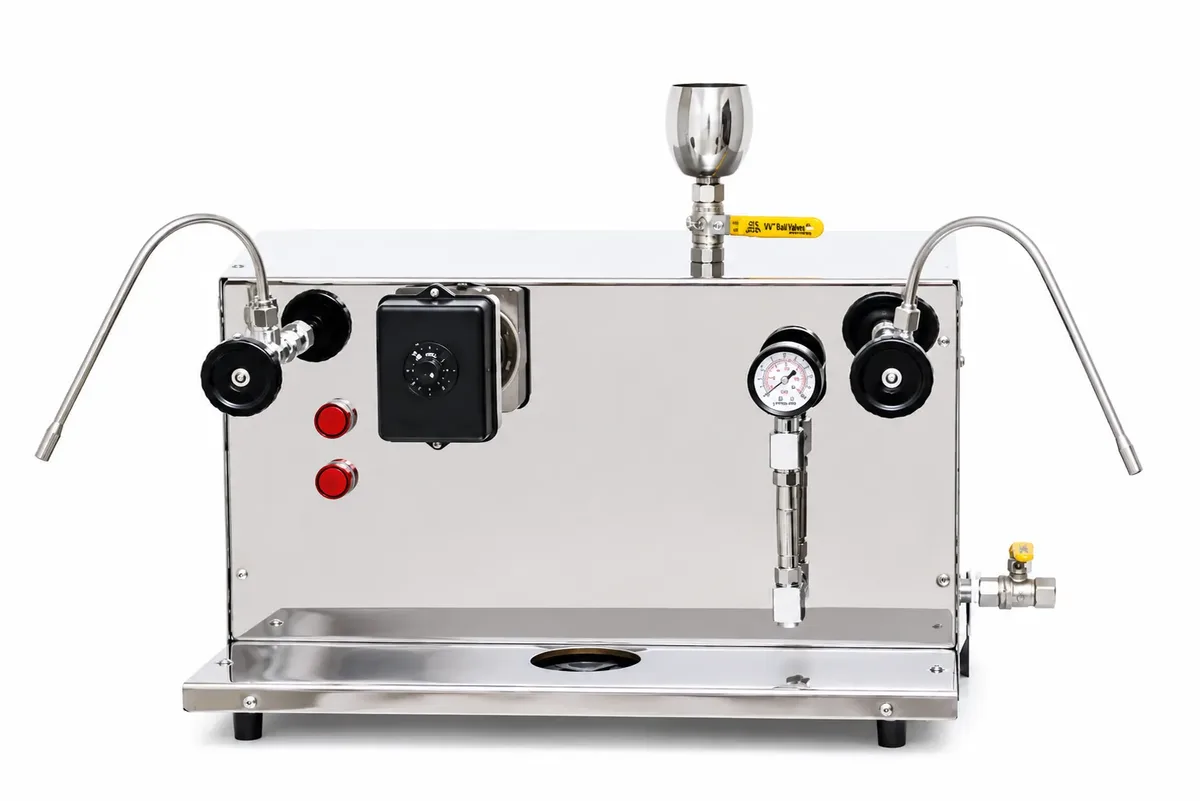
What a tea machine for shop counters actually changes
A chai ki dukan lives or dies on two things: how fast the counter clears in the rush, and how much of each cup's price you keep. A bhatti with one big vessel works against both. The vessel has to climb back to a boil every time it empties, which is exactly when the queue is longest, and whatever has been sitting on the flame since seven in the morning is not the cup a regular walked past two other stalls for.
A steam machine reverses that order. Heat is ready and waiting in the tank; you bring the milk to it. Pour a jug, drop the wand in, open the valve, and the milk boils and froths without a vessel having to climb back to a boil. Leaves, sugar, crushed adrak or masala go in on your judgement, the same as they do today, and each cup leaves the counter freshly made. The cylinder, the flame and the refill trip go away with the bhatti, and a 230V point takes their place.
Be clear that it is manually operated, not a unit that drops a finished cup on a button press — somebody works the wand.
How much counter space does it take?
Measure before you order, because on a stall the counter is the constraint that bites first. The three sizes are 17, 23 and 29 inch across, weighing 18, 24 and 33 kg with 8, 12 and 18 litre tanks. The 17 inch is the one built for a shop front: seventeen inches of width, which on a small kiosk counter is the space a large vessel and its bhatti were taking anyway.
At 18 kg the compact model is a two-person lift, and it needs a surface that will hold that much in one spot all day — a folding table or a thin ply board on trestles is not it.
| Size | Price (ex-GST) | Width | Weight | Tank | Power | Cups per hour |
|---|---|---|---|---|---|---|
| 17 inch Compact | ₹20,500 | 17 inch | 18 kg | 8 L | 1500W | ~200 |
| 23 inch Commercial | ₹23,500 | 23 inch | 24 kg | 12 L | 1500W | ~400 |
| 29 inch Heavy Duty | ₹29,500 | 29 inch | 33 kg | 18 L | 2000W | ~700 |
Can it carry your rush hour?
Count the cups you sell in your single busiest half hour — the train arrival, the shift change, the eleven o'clock break from the offices behind you. Double that figure to get cups per hour at your peak, then read it against the last column of the table above. If your busiest thirty minutes is eighty cups, you need a machine rated for around 160 an hour, and the compact size at roughly 200 has headroom on top of that.
Size on the peak, never on the day's total. Two stalls selling four hundred cups a day are not the same shop: one sells them in two sharp bursts and needs the headroom, the other trickles them out over fourteen hours and would be paying for a bigger tank to stand idle. Three practical notes on the sum:
- Count the cups you turned away or that walked off the queue last week, not only the ones you sold — those are the cups the machine is meant to recover.
- One person alone is limited by straining and serving, not by steam — the second wand pays off once a second pair of hands is behind the counter.
- If your peak sits between two sizes, take the larger. The bigger tank simply idles in the quiet hours; the smaller one makes people wait in the hour that pays your rent.
How do you work out payback on a tea shop machine?
A tea making machine for shop counters is a one-time cost set against a daily gain, so payback is a division sum. We will not print the answer, because we would have to invent your footfall and your prices to do it. Here is the formula, with your numbers in it:
machine price ÷ (extra cups per day × your margin per cup) = days to pay back
Take the price of the size you want from the table, or from the full price list. "Extra cups per day" is the honest part — not your whole daily sale, only the additional cups a faster counter lets you serve, which is the queue you currently lose plus whatever the fresher cup brings back. Your margin per cup is your selling price minus milk, leaves, sugar, the cup and your share of power. If you have never separated that out, the workings are in our tea stall profit margin guide, and a first-time budget covering counter, stock and licences — the whole tea stall setup cost — is in the guide to starting a tea stall business.
Run it twice, once with a pessimistic extra-cups figure and once with an optimistic one — the spread between the two answers tells you more than any single number. Use the ex-GST price in the sum: the 18% added on the invoice under HSN 8419 81 20 comes back as input credit if you are registered and eligible to claim it, which your accountant can confirm.
What else does the counter need?
The machine is one line on a longer list of tea stall equipment. You still need steaming jugs, a strainer, a decoction vessel if you keep liquor ready during peak, cups or kulhads, a milk store you can restock mid-shift, and a bin and cloth within reach of the wands, because a wand wiped after every jug is what keeps milk from baking onto the nozzle.
You also need a point. A tea maker machine for shop use in this range draws 1500W, or 2000W for the 29 inch, and it draws it for hours. Before delivery, have an electrician confirm that the point, the wiring and the MCB can carry that load continuously, ideally on a dedicated line with proper earthing — a steel-bodied machine handled with wet hands all day is not the place to be casual about earth. A counter point shared with a fridge, lights and a fan is the usual weak link on a stall.
As a coffee machine for shop counters the same unit doubles up: the second wand froths milk for instant or filter-decoction coffee while chai goes out on the first, and the hot-water outlet covers black tea, green tea and lemon tea without heating a separate pan. On a counter with room for exactly one appliance, a tea coffee machine for shop use earns its width twice over.
Who should not buy one of these
If you sell twenty or thirty cups a day from a small side-street shop, this is too much machine. The sum in the payback section will tell you so plainly, and a stove and a vessel will serve you better until your footfall grows. If nobody can stand at the counter — an unmanned corner in a showroom, a night shift with no staff — this is the wrong category, because the operator is part of how the chai gets made. If your menu needs ground beans and shots pulled under pressure, that is not this machine either; it steams and froths milk rather than brewing from beans. And if your supply cannot hold 1500W all day and you are not willing to get the wiring sorted first, wait until it is done, because that is the one part of the install nobody can do over WhatsApp.
Getting one to your counter
Send us your city, your busiest-half-hour cup count and your counter width on WhatsApp, and we will tell you which size the numbers justify — including when the 17 inch is plenty and the bigger one would be money parked. Booking takes a ₹2,000 advance, and the balance is paid when the machine reaches the transport office in your city; the transport charge itself depends on the city and is confirmed before you pay anything. Dispatch is within 24 to 48 hours, road transit runs 3 to 8 days, and the machine travels in a wooden crate, with transit damage replaced. Once it is on your counter, a video call in Hindi or English walks you through first pressure, first jug and the five-minute daily clean that keeps the tank warranty intact.