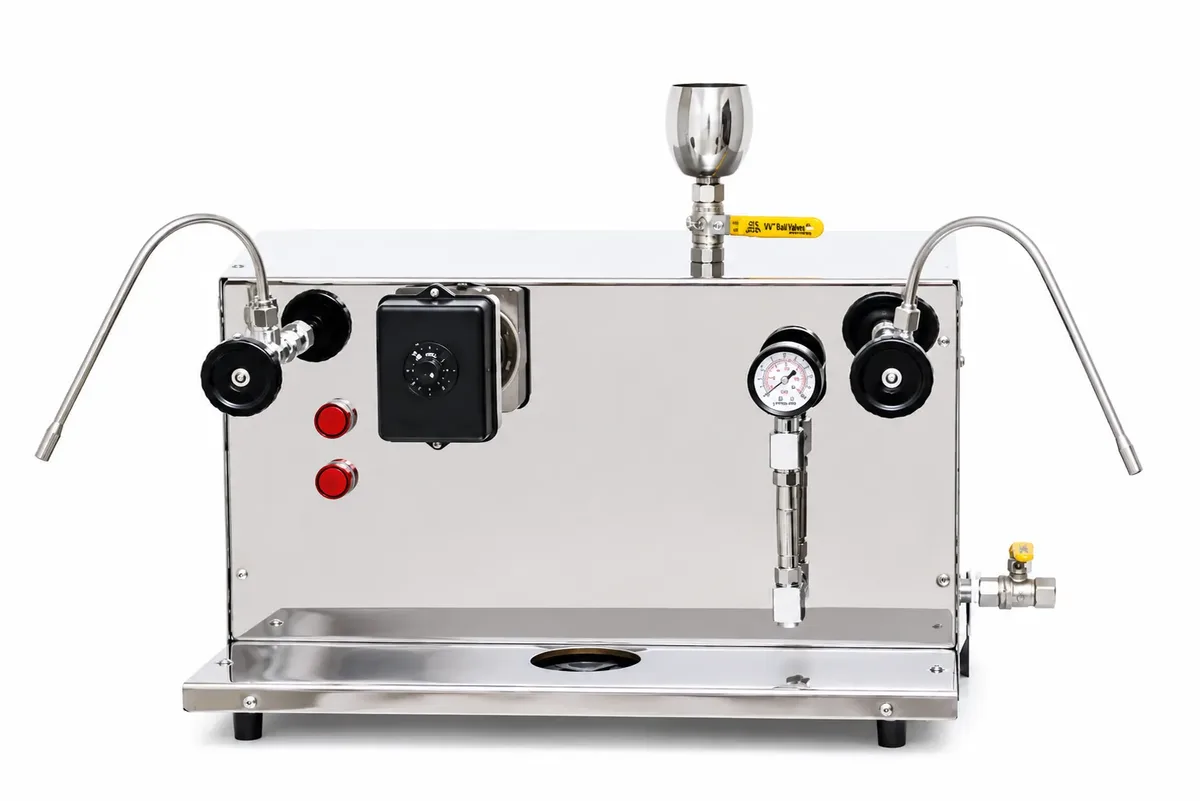
Karmayogi Tea Coffee Machine

Tea and Coffee Machine: One Steam Unit, Both Drinks

₹20,500 to ₹29,500 + 18% GST · three sizes · delivered across India with a GST invoice

One boiler, two steam wands and a hot-water outlet — chai on one wand, frothed milk for coffee on the other, green tea from the tap, all from a single 230V point.

If your counter has to send out chai and coffee from the same two hands, a tea and coffee machine saves you buying two appliances and giving up twice the counter space. The steam unit on this page does both because both drinks need the same thing: milk heated hard and fast, plus hot water on demand. This page sets out the full drink list one unit covers, how an operator moves between tea and coffee mid-rush using the two wands, the size that fits your mix, and the honest limits of what a steam machine will and will not do.

Quick answer

A tea and coffee machine of this type is a single steam boiler that serves both drinks instead of two separate appliances. Water heats inside a sealed SS 304 tank until it holds pressure, and that pressure feeds two brass-fitted steam wands plus a hot-water outlet. Chai is made by steaming milk with leaves, sugar and adrak in a jug. Coffee is made by steaming plain milk to a froth and pouring it over instant coffee or filter decoction. The tap gives plain hot water straight off the same tank for green tea, black tea or lemon tea. Three sizes exist — 17, 23 and 29 inch — listed from ₹20,500 to ₹29,500 ex-GST, rated 1500W to 2000W on a 230V single-phase supply, and capable of roughly 200 to 700 cups an hour. An operator runs it throughout; the machine supplies heat and pressure, never the recipe.

By Karmayogi Tea Coffee Machine Team · Last updated

  • GST Invoice
  • Made in India
  • SS 304 Tank
  • 5 Year Tank Warranty
  • Pan-India Delivery

Why this machine

What You Get with This Tea and Coffee Machine

  • Both drinks, one counter slot

    Chai, instant or decoction coffee with steamed milk, plain hot milk, badam milk and hot water for green or black tea — all off one boiler, with no second appliance to buy or plug in.

  • Two wands run in parallel

    Keep the chai jug on one brass-fitted wand and plain milk for coffee on the other, so a mixed order does not become a queue. The hot-water outlet handles tea bags without touching either wand.

  • Your own milk, your own coffee

    Fresh milk in a jug, your own tea leaves, your own coffee jar or filter decoction. Nothing is locked to a pouch you have to reorder, so your per-cup cost stays under your control.

  • Three sizes, direct from Ahmedabad

    17, 23 and 29 inch with 8, 12 and 18 litre SS 304 tanks, 5-year warranty against tank leakage, GST invoice on HSN 8419 81 20 and no dealer in between.

Sizes & prices

Three Sizes, One Steam Machine

Same build and warranty in every size — pick by your rush-hour volume.

17 Inch Compact

Tea stalls & small shops

₹20,500+ 18% GST

  • Up to 200 cups/hour
  • Electric only (2 steam wands)
  • 1500W · 8L tank · 18 kg
MOST POPULAR

23 Inch Commercial

Cafes, restaurants & canteens

₹23,500+ 18% GST

  • Up to 400 cups/hour
  • Electric only (2 steam wands)
  • 1500W · 12L tank · 24 kg

29 Inch Heavy Duty

High-volume outlets & caterers

₹29,500+ 18% GST

  • Up to 700 cups/hour
  • Electric only (2 steam wands)
  • 2000W · 18L tank · 33 kg
Twin steam wands and the hot-water outlet on the 23 inch unit — one wand for the chai jug, one for plain milk, the tap for green and black tea.
Body materialStainless steel, SS 304 tank
HeatingElectric heating element (no gas required)
Steam wands2 (milk frothing + hot water/tea)
SafetyPressure gauge, safety valve, water-level glass
Power supply230V single phase
Warranty5 years against tank leakage
Made inIndia
Ideal useFresh-milk chai, coffee, milk frothing, hot water

What does a tea and coffee machine actually make?

One steam unit does three simple things. It boils water under pressure in a sealed SS 304 tank, pushes that pressure through two brass-fitted steam wands into whatever jug you hold under them, and draws plain hot water off the same tank through a separate outlet. Chai needs the first two. Coffee needs the wand for milk and nothing else, because the coffee itself is already waiting in the cup. Green tea and black tea need only the tap. That is the whole reason a single body carries a two-drink menu — the drinks differ in the cup, not in the heat they demand.

There is no chai button and no coffee button on the front. What you see is a pressure gauge, a safety valve, two wand valves and the hot-water tap. Everything after that is the operator's judgement: how long the leaves steep, how thick the froth sits, how much sugar goes in. A commercial tea and coffee machine bought on this principle survives a menu change, because a new drink means a new jug, not new equipment.

The drink list one unit covers

  • Kadak or cutting chai — milk, leaves, sugar and crushed adrak or masala steamed together in the jug, then strained.
  • Instant coffee — a spoon of coffee and sugar in the cup, hot steamed milk poured over, froth on top.
  • Filter or decoction coffee — strong decoction kept ready in a flask, topped with milk frothed on the wand for a thick cappuccino-style head.
  • Plain hot milk — one pass on the wand, useful for children and late-evening orders.
  • Badam milk and haldi doodh — the same steam, with your own mix stirred in before or after.
  • Green tea, black tea, lemon tea and herbal infusions — hot water straight from the outlet over the bag or leaves.

Two things are not on that list. The machine will not grind beans and does not pull espresso shots — that is a different category of equipment with a different price. It also does not dispense a flavoured premix from a pouch, because there is no pouch anywhere in the system; you buy milk, leaves and coffee the way you already do. If pouch-based dispensing is what you are comparing against, the trade-offs are laid out in our tea machine vs vending machine guide.

How do you switch between tea and coffee during a rush?

You mostly do not switch. You assign. Give the left wand to the chai jug and the right wand to plain milk, keep decoction ready in a vessel or flask before the rush starts, and the two drinks stop competing for the same nozzle. Order by order, it works like this.

StageCup of chaiCup of coffee
Kept ready beforehandStrong tea decoction in a vessel; sugar and masala within reachInstant jar or filter decoction in a flask; cups pre-loaded
On the wandMilk plus leaves, sugar and adrak steamed together in the jugPlain milk steamed alone until it froths
In the cupStrained through a sieve into glass or kulhadFrothed milk poured over the coffee already in the cup
Typical add-on orderGreen tea, straight from the hot-water outletPlain hot milk, one short pass on the free wand
Between ordersWipe the wand, short steam purgeWipe the wand, short steam purge

Three practical points follow. A mixed order — two chai, one coffee — is one pass on each wand rather than three trips to a stove. A green tea order goes straight from the hot-water outlet while both wands stay busy. And the wand carrying plain milk stays cleaner than the chai wand, because nothing sugary or masala-heavy dries on it.

The limit is hands, not steam. One person can hold a jug, strain the previous one and take money, and that is roughly the ceiling on a 17 inch unit. A menu that genuinely runs both wands flat out through a rush wants a second person at the counter, and that is the moment a bigger tank starts paying for itself.

Which size fits the mix you plan to sell?

SizePrice (ex-GST)Cups per hourTankPowerWeightBest suited to
17 inch₹20,500~2008 L1500W18 kgKiosks and small counters, chai-led with a few coffees
23 inch₹23,500~40012 L1500W24 kgCafes, restaurants and office pantries with a genuinely mixed menu
29 inch₹29,500~70018 L2000W33 kgCanteens, hostels and caterers serving both drinks in waves

Size on the half hour that hurts, not on the day's total. A mixed menu tilts the answer upward, because a coffee order uses the wand for plain milk and then a second pour, occupying the machine slightly longer than a straight chai counter. If you are hesitating between two sizes, the larger tank holds pressure through the peak instead of recovering between orders. An office pantry serving fixed break times has the same problem in a sharper form — that scenario is worked through on our office tea coffee machine page, and the frothing technique itself is covered on the coffee steamer machine page.

What does the tea and coffee machine price in India include?

The tea and coffee machine price in India is a hard figure to read, because search results for it mix home appliances, steam units like this one and heavy cafe equipment on a single page, so the numbers are not describing the same product. A coffee tea machine price quoted for a home appliance and a coffee and tea machine price quoted for a commercial boiler are answering two different questions. Our list is published in full, size by size, on the price list page — that page is the place to compare figures, and this one is for deciding whether the machine suits your menu.

What the listed figure covers is worth spelling out: the machine, both steam wands, the pressure gauge and safety valve, and a 5-year warranty against tank leakage on the SS 304 tank. Faults are diagnosed on a WhatsApp video call in Hindi or English and spares such as the element, gasket, wand nozzle, gauge or valve are couriered from Ahmedabad within 48 hours. Prices are ex-GST and 18% GST is added on the invoice under HSN 8419 81 20, which a registered business eligible to claim it can take as input credit — check your own position with your accountant. Transport is quoted separately because it depends on your city, and it is confirmed on WhatsApp before you pay anything. Dropping it, running the tank dry, unauthorised modifications and scale from skipped descaling are not covered by the tank warranty.

Running cost you can calculate yourself: a 1500W element drawing power for an hour uses 1.5 units and a 2000W element uses 2, so multiply your commercial tariff by that and divide by the cups you serve in the hour. The element cycles on and off to hold pressure, so the real figure sits below that ceiling. Milk and coffee remain the larger cost by a distance.

Who should not buy this two-drink machine

Three kinds of buyer should look elsewhere, and it is cheaper to find out now. If your menu is built on shots pulled from freshly ground beans, this is the wrong machine — it neither grinds nor extracts under pressure. If you want a unit that hands a finished cup to a customer with nobody behind the counter, this is not automatic and never will be; someone holds the jug for every cup. And if you serve fifteen cups a day at home, a commercial boiler on your kitchen counter is money badly spent. One more check before booking: the machine needs a 230V single-phase point that can carry 1500W to 2000W all day, so have an electrician confirm the point, the wiring, the MCB and the earthing before delivery.

Booking, delivery and your first shift

Send your city and a rough split of how many chai and how many coffee cups you expect in your busiest hour, and we will name a size — including telling you when the smaller one is enough. Booking takes a ₹2,000 advance and the balance is paid when the machine reaches your city transport office. Dispatch is within 24 to 48 hours from Ahmedabad, road transport takes 3 to 8 days, and the unit travels in a wooden crate with transit damage replaced. Once it is on your counter, a video call in Hindi or English walks you through first pressure, first chai and first frothed milk, plus the five-minute daily clean and the descaling schedule that protects the element. If you are still deciding between machine types for a new outlet, start with our buying guide for small businesses.

How Ordering Works

  1. 1

    Enquire

    WhatsApp or call us with your city and business type. Get final price with transport quote.

  2. 2

    Book with ₹2,000

    Pay a small advance by UPI or bank transfer to confirm your machine.

  3. 3

    Secure dispatch

    Machine packed in a wooden crate, dispatched by road transport with bilty tracking.

  4. 4

    Balance on delivery

    Pay the remaining amount when the machine reaches your city. GST invoice included.

Tea and Coffee Machine FAQs

Does it grind beans or make espresso?

No. It does not grind beans and it will not extract espresso, so a menu built on shots needs different equipment altogether. What this machine gives coffee is steam: plain milk boiled and frothed on a brass-fitted wand with no pan on a flame, poured over instant coffee or over filter decoction you have kept ready. The result is a strong milk coffee with a thick foam on top, not a pressure-extracted shot from freshly ground beans. We would rather you know that before booking than after the crate arrives.

Can one person serve chai and coffee at the same time?

Yes, within limits. Because there are two wands, plain milk for coffee can froth on one while a chai jug steams on the other, and the hot-water outlet handles a green tea order without occupying either. The bottleneck is the pair of hands, not the boiler: one operator can hold a jug, strain the last one and take payment, which is comfortable on a 17 inch unit. If both wands need to run continuously through your peak, plan for a second person and a bigger tank.

Why is the same machine sold under so many different names?

Search habits drive the naming, not engineering differences. One seller lists the same steam unit under a tea coffee maker machine price heading; the next calls it a coffee and tea maker machine. Ignore the label and read the specification: tank steel grade, rated wattage, number of steam wands, and how long the tank is warranted against leakage. Ours is SS 304 at 8, 12 or 18 litres, 1500W or 2000W, two brass-fitted wands, and a 5-year warranty against tank leakage. Once you are comparing those lines, the title on the page stops mattering.

Do both steam wands need cleaning if one is only used for coffee?

Yes, both — and daily. The wand used for plain milk looks cleaner because nothing sugary dries on it, but milk protein still bakes onto a hot nozzle and will taint the next jug. Wipe each wand with a damp cloth right after every use and purge a short blast of steam through both at closing to clear what sits inside. The body gets a daily wipe, the tank a weekly drain and rinse, and descaling happens on schedule in hard-water areas because scale damage is not covered by the tank warranty.

Will the coffee froth hold up like a cafe cappuccino?

The steam is strong enough to lift a thick, stable foam on fresh milk, and the technique matters as much as the machine: keep the nozzle just under the surface to draw air in for a few seconds, then sink it deeper to spin the milk smooth. Full-cream milk froths denser than toned milk. What you get is a cappuccino-style cup — frothed milk over instant coffee or decoction — rather than a crema-topped shot, because the coffee base is brewed by you and not extracted by the machine.

Can it handle green tea, black tea and plain hot water too?

That is what the separate hot-water outlet is for. It draws hot water straight off the same tank, so a green tea, black tea, lemon tea or herbal infusion order is poured without going near either steam wand or leaving milk residue in the cup. It is also the quickest way to get hot water for warming a vessel or rinsing a sieve mid-shift. Because it shares the boiler, heavy hot-water use does draw on the same pressure your wands are using, which is another argument for the larger tank on a mixed menu.

What electrical supply should be ready before the machine arrives?

A dedicated 230V single-phase point with proper earthing, rated for the size you buy: 1500W for the 17 and 23 inch units, 2000W for the 29 inch. That is geyser-level load, and it should not share a circuit with fans, lights and a fridge. Ask an electrician to check the point, the cable, the MCB rating and the earth connection, and to confirm the circuit can carry that load continuously through a full shift. Earthing deserves particular attention because this is a steel body handled with wet hands all day long.

Get Your Best Price for a Tea and Coffee Machine

We reply within working hours, usually in minutes. No spam.

Other machine types

  • Tea Making Machine

    A steam tea making machine that boils and froths fresh milk on your counter — 200 to 700 cups an hour from a single 230V point, with no gas cylinder in the shop.

  • Chai Machine

    Steam wali chai machine jo aapke counter par asli doodh bina kisi intezaar ke ubaal deti hai — 200 se 700 cup ghante ke, ek 230V point par, dukan mein bina cylinder rakhe.

  • Office Tea Coffee Machine

    Fresh-milk chai and frothed-milk coffee from one pantry counter — sized by your headcount and your break, billed with a GST invoice your accounts team can claim.

  • Coffee Steamer Machine

    A coffee steamer machine built around two brass-fitted wands: drop one into a jug and dry steam heats and froths fresh milk with no pan on a flame, on a single 230V point.

  • Electric Tea Machine

    An electric tea machine that works off a single 230V point — nothing to book, nothing to carry upstairs, and a fuel cost you can calculate from your last electricity bill before you buy.

  • Tea Machine for Shop

    Seventeen inches of counter, one 230V point, and every cup steamed to order — the compact size is built for a chai ki dukan where the counter is the whole shop.

  • Commercial Tea Machine

    Built for institutional duty: an 18 litre SS 304 pressure tank, twin brass-fitted steam wands and a 2000W element that keeps pouring through a shift break — about 700 cups an hour from one 230V point.

Full 2026 price list with GST notes →