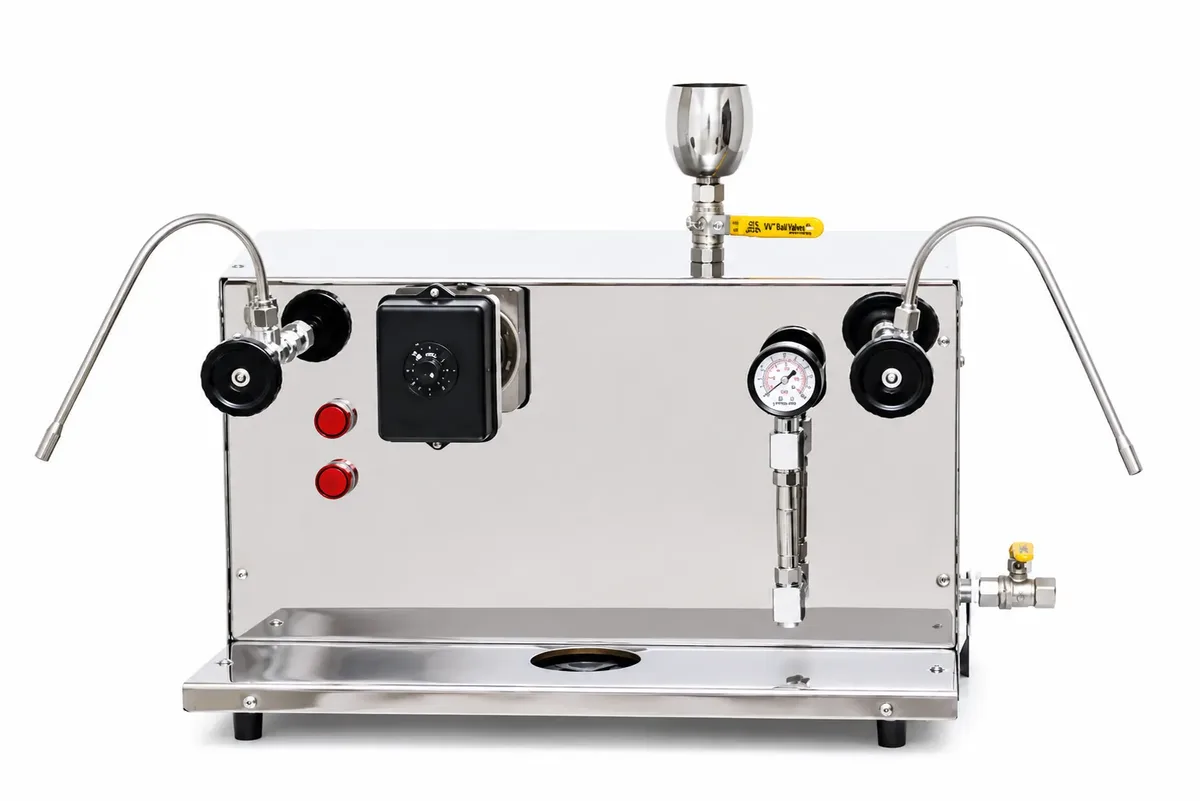
What makes a tea machine commercial rather than domestic?
Take the panels off and the answer is in four parts. The tank is SS 304 stainless — 8 litres on the 17 inch, 12 litres on the 23 inch, 18 litres on the 29 inch — a sealed vessel heated until it holds steam pressure, not an open pan sitting on a coil. The element inside is rated 1500W on the two smaller sizes and 2000W on the 29 inch, sized to bring that volume back up to pressure while the counter keeps working instead of pausing to reheat. Both steam wands are brass-fitted at the joint. The pressure gauge on the front makes the tank readable before anyone opens a wand, and the safety valve above it relieves pressure that climbs past the safe point.
The outside earns its keep just as hard. The body is stainless steel, so the wet cloth a hospital pantry or a mess kitchen gives it at closing time does not start rust at the seams. Weight is the other number worth recording, at 18 kg, 24 kg and 33 kg. The written spec — steel grade, tank volume, element wattage, warranty terms — is what makes two weights comparable at all. And the parts that wear — gasket, wand nozzle, element — are couriered out as replaceable parts rather than sealed in.
How many cups does your shift break actually need?
Size a commercial tea coffee machine against the worst thirty minutes of the day, never the daily total. Three hundred workers on one 20-minute break is a harder job than the same three hundred cups spread across a hostel mess breakfast. Work it out in four steps before you look at price:
- Take the headcount served in your single largest break, not the headcount on the roll.
- Multiply by the cups each person takes — count two where chai and coffee both go out.
- Divide by the length of the break in minutes and multiply by 60. That is the cups-per-hour rate you have to buy for.
- Pick the size above that number, not the one that just meets it — a machine that only just copes on paper is the one that holds up the queue.
| Size | Tank | Element | Weight | Cups per hour | Price (ex-GST) | Built for |
|---|---|---|---|---|---|---|
| 17 inch | 8 L | 1500W | 18 kg | ~200 | ₹20,500 | Ward pantry, site office, small staff room |
| 23 inch | 12 L | 1500W | 24 kg | ~400 | ₹23,500 | Mid-size canteen, hostel mess, banquet counter |
| 29 inch | 18 L | 2000W | 33 kg | ~700 | ₹29,500 | Factory canteen, hospital canteen, catering kitchen |
Two wands change the arithmetic as much as tank volume does. One person steaming and straining alone is limited by hands, not by steam; put a second person on the second wand and both work off the same tank. A caterer running a commercial chai machine at a function needs that second pair of hands for forty minutes and nobody at all for the rest of the evening, which is the pattern the 29 inch size is built around. The hot-water outlet works alongside both wands, so a commercial hot tea maker on a canteen counter pours green tea, black tea or hot water for soup while milk is steaming. Full specifications sit on the price page, and how a single cup is steamed is covered on our tea making machine page.
Daily, weekly and periodic: the maintenance schedule
Institutional machines fail for boring reasons: dried milk in a nozzle, scale on an element. Put the schedule below on the shift roster with a named person against it.
| When | Task | Why it matters |
|---|---|---|
| Daily | Wipe both wands after each jug, purge a blast of steam through each one at closing, wipe the body down, check the water level before the first shift | Milk that dries in a nozzle chokes the steam; an element must never run in a dry tank |
| Weekly | Drain and rinse the tank, check both wand tips for a partial block, confirm the gauge returns to zero when the machine is cold | Catches a weak wand or a sticking gauge on a quiet day instead of during a break |
| Periodic, more often in hard-water areas | Descale the tank and element with a food-safe solution and flush through with clean water | Scale slows heating, and scale damage from skipped descaling is not covered by the tank warranty |
Water hardness sets the descaling interval, so a mess on borewell supply needs it more often than one on treated municipal water — judge by how quickly the tank films up, not by a date. Our maintenance guide covers the same routine in detail, including which faults are worth a support call rather than a screwdriver.
What does procurement need on the invoice?
Listed prices are before tax. The invoice adds 18% GST under HSN 8419 81 20, the code we invoice under, and a GST-registered buyer that is eligible to claim it can take that 18% as input credit — worth confirming with your own accounts team, because eligibility turns on what your organisation supplies and how the machine is used, not on the invoice alone. Give us your GSTIN before we raise the invoice and the classification and tax split are right from the start; the codes that get confused with this one, and what a wrong code does to a credit claim, are explained in our GST and HSN guide. A commercial tea and coffee machine bought this way is capital equipment on your books, and the invoice is also what a tank warranty claim is filed against, so route a copy to whoever keeps asset records.
The SS 304 tank carries a five-year warranty against leakage. That tank warranty does not cover drops, running the tank dry, unauthorised modifications, or scale left by skipped descaling — the four exclusions this commercial tea maker warranty carries, and the reason the schedule above is worth assigning to a person. When something goes wrong, at any point in the life of the machine, we diagnose it on a video call in Hindi or English and courier the part — element, gasket, wand nozzle, gauge or valve — from Ahmedabad within 48 hours. There are no dealers and no showrooms in between: the machine is made in India and sold direct from Ahmedabad, so the person who answers is the person who can send the part.
Warranty, payment and dispatch terms
- Booking takes a ₹2,000 advance; the balance is paid when the machine reaches the transport office in your city.
- Transport is charged separately, depends on the destination city, and is confirmed on WhatsApp before you pay anything.
- Dispatch is within 24 to 48 hours of booking, and road transport takes 3 to 8 days depending on the city.
- The machine travels in a wooden crate and transit damage is replaced.
- Setup is a video call: fill the tank, plug into the point, and we take your staff through the first jugs.
Before delivery, have your electrician confirm the 230V single-phase point, its wiring and the MCB can carry 1500W or 2000W continuously, and that earthing is sound — this is a steel-bodied machine handled with wet hands. Specify a dedicated point rather than a socket shared with the fridge and the exhaust fan.
Who should not buy this commercial tea machine
If your requirement is an unattended counter — a cup handed to a visitor at midnight with nobody on duty — this is the wrong category, because an operator steams the milk and makes the chai here. It is not a powder-dispensing unit either: you keep buying milk, leaves and sugar rather than pouches. If your canteen pours well under a hundred cups on your busiest day, even the smallest size is more machine than the job needs. And if the kitchen has no spare electrical capacity and no budget to run a point, fix that first, because a commercial coffee tea machine on an overloaded line is a fault waiting for the busiest morning of the month.
Getting a quote for your canteen
Send your city, your largest break headcount and the length of that break on WhatsApp, and we will tell you which size fits — including when the 23 inch is enough and the 29 inch is money you do not need to spend. If your process needs a proforma carrying your GSTIN before the advance is released, ask for it, and we will add your city's transport figure so the number reaching finance is final.