What does this tea coffee machine manufacturer actually make?
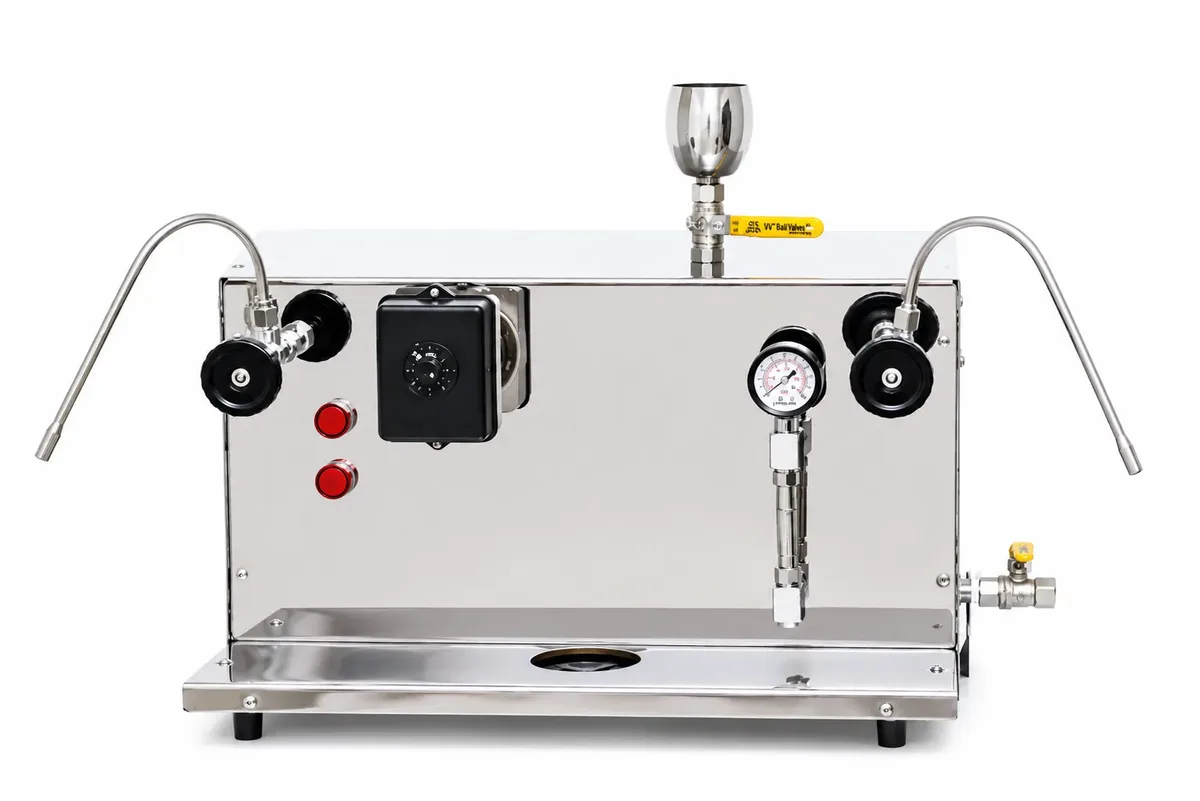
One machine, built properly, in three widths. The tank is SS 304 stainless steel, sealed and heated by an electric element until it holds steam pressure. That pressure feeds two steam wands with brass fittings at the joint, plus a hot-water outlet beside them. On the front sit a pressure gauge, a safety valve and a water-level glass, so whoever is on the counter can read the tank before opening a wand. The whole assembly is wrapped in a stainless steel body that takes a wet cloth at closing time. Milk is steamed in a jug at the wand; leaves, sugar, adrak and masala stay in the operator's hands, which is why the chai tastes like it came off a stove rather than out of a dispenser.
We are a tea machine manufacturer in the narrow sense of the word. We do not make vending machines, we do not sell premix, and we are not a coffee tea machine suppliers' catalogue listing forty models from forty factories. The design decisions — steel grade, element wattage, wand fittings, the warranty we are prepared to put in writing — are ours, and so is the responsibility when a part fails. This is an Indian tea machine in the plain meaning of the phrase: drawn up around full-cream milk boiled with leaves for a queue of people who want their cup in under a minute, and built in India for Indian supply voltages.
| Size | Tank | Cups per hour | Element | Weight | Price (ex-GST) |
|---|---|---|---|---|---|
| 17 inch | 8 L | ~200 | 1500W | 18 kg | ₹20,500 |
| 23 inch | 12 L | ~400 | 1500W | 24 kg | ₹23,500 |
| 29 inch | 18 L | ~700 | 2000W | 33 kg | ₹29,500 |
Each size runs from one 230V single-phase point. The price page carries the complete specification and the current list, and the commercial tea machine page covers institutional duty cycles in detail. Every unit leaves the same tea making machine factory floor in Ahmedabad, so the fifth machine you order matches the first.
Manufacturer, supplier, dealer or vendor: what is the difference when you buy?
Search results blur four words that mean four different things once money changes hands. A tea coffee machine manufacturer builds the machine and controls the drawing, the steel and the warranty wording. A tea coffee machine supplier may be the maker, or may be a trading company that buys from one and invoices you under its own name. A tea coffee machine dealer holds stock for a maker in one territory and earns a margin on each unit it moves. A tea coffee machine vendor is simply whoever sold it to you, including a marketplace seller who has never had the machine in the same room.
| You buy from | Who sets the price | Who honours the warranty | Who holds the spares |
|---|---|---|---|
| The manufacturer | The factory, published or quoted direct | The factory | The factory |
| A supplier or trading company | The supplier, with its margin added | Whoever its paperwork names | Ordered in when you ask |
| A dealer | The maker's list plus a territory margin | The maker, through the dealer | The dealer, if it stocks them |
| A marketplace vendor | The listing | Whoever the listing points to | Unknown until you need one |
None of these is dishonest in itself. A dealer with a stocked shelf in your city can be a perfectly good way to buy. The problem is only that the words are used loosely, so a tea coffee machine company on a listing may be any of the four, and what it has put on paper, not its label, decides what happens in year three when the element goes. A chai machine manufacturer and a tea machine company are the same thing described in two languages; search for either, and the page you land on should be able to answer the six questions below without a pause.
How to verify a tea machine manufacturer before you pay
Run every maker through the same list, including us. A manufacturer answers each point from memory; a reseller has to go and ask.
- Ask for the GSTIN and check it on the GST portal. The first two digits are the state code, and the registered name should be the name on your invoice. Ours starts with 24, the code for Gujarat, and is printed on the About page beside the registered address in Nikol, Ahmedabad.
- Ask which HSN code the invoice will carry. Steam tea and coffee machines are invoiced under 8419 81 20 at 18% GST. A different code is a question to raise before the advance, not after; the near-miss codes and what a wrong one does to your input credit are set out in our GST and HSN guide.
- Ask for steel grade, tank litres, element wattage and weight in writing. Ours are SS 304, 8, 12 and 18 litres, 1500W, 1500W and 2000W, 18, 24 and 33 kg. A maker can quote these before you finish asking.
- Ask who honours the warranty and who ships the spare part. The answer should be one company at one address, and it should match the GSTIN above.
- Ask for a video of the machine steaming a jug, not a studio photograph. A factory can shoot one on the line the same afternoon.
- Ask what happens to transit damage. The honest answer is a replacement, not a claim form.
When you compare tea coffee machine manufacturers in India, put these six questions to each of them in the same order and keep the written replies. The gap between the ones who answer and the ones who stall is the whole buying decision, and it costs you nothing but a few WhatsApp messages.
Buying direct from Ahmedabad: what changes on the invoice and after delivery
On the invoice, three things change. First, the price you see is the price the factory charges — published ex-GST on this website, with 18% added under HSN 8419 81 20 and shown as IGST for a buyer outside Gujarat or as CGST plus SGST for one inside it. Second, the GSTIN on that invoice belongs to the company that made the machine, so a GST-registered buyer eligible to claim the tax has a clean document for the credit, something your accounts team should confirm against your own registration. Third, there is no dealer code, regional price list or second bill for the same machine from a different name.
The booking runs the same way for every size and every state:
- A ₹2,000 advance books the machine; the balance is due when it reaches the transport office in your city.
- Transport is charged separately, depends on your city, and is confirmed on WhatsApp before any money moves.
- Dispatch is within 24 to 48 hours of booking, and road transport takes 3 to 8 days — Rajkot and Surat are a day away, Coimbatore and Chennai sit at the far end of the range.
- The machine travels in a wooden crate, and transit damage is replaced rather than argued over.
- Commissioning happens over a video call on the day the crate is opened: your staff fill the tank, switch on, and steam the first jugs with us watching.
After delivery, the relationship stays with the maker. The SS 304 tank carries a five-year warranty against leakage; drops, running the tank dry, unauthorised modification and scale from skipped descaling fall outside it, which is why the maintenance guide is worth pinning up beside the machine. When something fails at any point in the machine's life, the fault is worked through on a video call in Hindi or English, and the part — element, gasket, wand nozzle, gauge, safety valve or level glass — is couriered from Ahmedabad within 48 hours of that call. The person diagnosing it has the drawing in front of them, because it is their drawing.
Multi-unit orders for chains, canteen contractors and franchises
If you are buying a tea coffee machine for business use across more than one site — a chai chain adding outlets, a canteen contractor holding four factory contracts, a cafe franchise opening its fifth counter — the arithmetic changes in three ways, and all three favour buying from the maker.
The first is spares. Because the 17, 23 and 29 inch share the same wand fittings, gasket pattern and gauge, one kit box of consumables covers a kiosk, a mid-size outlet and a flagship. The second is paperwork: several machines can go on one invoice with your GSTIN, or on one invoice per delivery address if your accounts prefer it, and dispatch can be staggered to match fit-out dates rather than landing every crate in one week. The third is consistency. Every unit comes off the same line in Ahmedabad to the same drawing, so staff trained on the machine at outlet one can walk into outlet six and steam the first jug without a briefing.
There is no minimum order beyond a single machine, and there is no minimum for a quote. We do not run a dealer or distributor network, so a buyer with twelve sites deals with the same factory as a buyer with one, at the same published list, with transport worked out per destination. Send the list of cities and the expected busiest-hour volume at each, and the reply will say which size belongs where — including which outlets are better served by the 17 inch than the 23.
Who should look for a different manufacturer
A factory that makes one thing should also say plainly what it does not make. If you need an unattended counter where a cup appears when a coin or a card goes in, this is not a vending machine and we are not the right maker for that job; the differences are laid out in our steam machine versus vending machine guide. We do not sell premix or sachets, so there is no supply contract behind the purchase and nothing to re-order from us every month. It is not an espresso machine: it does not grind beans or pull a shot under pump pressure, though its wands froth milk for instant or filter-decoction coffee. It is not automatic: an operator steams every jug and controls every recipe. It is not imported and it is not Italian, and a tender that requires foreign-origin equipment is one we will tell you to take elsewhere before anyone spends time on a quote.
Get a factory-direct quote
Send your city, how many outlets you are buying for, and the number of cups you pour in your busiest hour on WhatsApp. The reply will name the size for each site, the transport figure for each city, and the total with GST shown separately. If your process needs a proforma carrying your GSTIN before the advance is released, ask for it in the same message and it will come back with the transport line already filled in.