
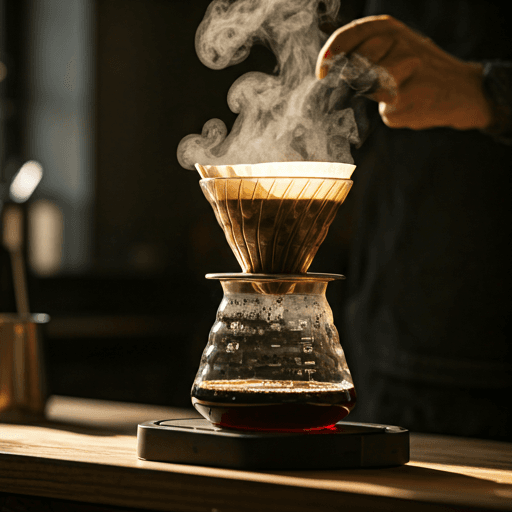
If you have been typing filter coffee near me into your phone hoping for a proper, frothy South Indian kaapi rather than a watery instant cup, this guide is for you. The short answer: great filter coffee near you usually lives in three places: traditional South Indian mess and tiffin joints, dedicated filter coffee houses and roaster cafes, and increasingly, the office or home brewer you set up yourself. Below we cover exactly how to find the good ones, what separates real kaapi from the rest, and how to get that same cup repeatable on your own counter.
What you are actually searching for when you type "filter coffee near me"
South Indian filter coffee, also called kaapi, degree coffee, Madras filter coffee or Mysore filter coffee, is a drip brew made in a two-chamber metal filter. Hot coffee decoction drips slowly through finely ground beans (usually blended with chicory), and that thick decoction is mixed roughly one part decoction to three parts hot milk, with sugar. The cup is then pulled back and forth between a davara (a wide metal saucer) and a tumbler from a height, which cools it slightly and builds the signature froth.
So when you search "filter coffee near me," you are really after that specific decoction-and-frothy-milk profile, not a drip-machine americano or an instant sachet. Knowing this changes how you read the search results, because plenty of places that show up serve coffee, but not real kaapi.
The three kinds of results you will get
- Traditional tiffin and mess joints: Saravana Bhavan, Murugan Idli Shop, A2B, Brahmin's, local Udupi messes and old-town darshinis. These are usually the most authentic and the cheapest, with kaapi often INR 20 to INR 60.
- Filter coffee houses and South Indian roaster cafes: Dedicated spots that take decoction seriously, sometimes grinding single-origin beans from Chikmagalur, Coorg or Araku. Expect INR 60 to INR 150 a cup.
- Modern cafe chains: Many show up for the search but serve espresso-based drinks. Some now offer a "filter coffee" on the menu; quality varies a lot.
How to judge a great filter coffee near you (before you order)
Maps and delivery apps will rank by rating and distance, but ratings rarely tell you about the coffee itself. Use these India-specific signals to separate a genuinely good cup from a tourist-trap one.
| Signal | Good sign | Warning sign |
|---|---|---|
| Serving vessel | Steel davara and tumbler, served frothy | Paper cup, flat surface, no froth |
| Decoction | Made fresh, dark and aromatic | Pre-mixed, reheated, watery |
| Milk | Full-fat, boiled, properly hot | Lukewarm, thin, over-sweetened to hide it |
| Crowd | Steady local regulars at breakfast | Empty at 8.30 am on a weekday |
| Menu honesty | Says "filter coffee" or "degree kaapi" | Lists only "coffee" with no detail |
A reliable trick: read the photos in the reviews, not just the star rating. If reviewers consistently photograph a frothy steel tumbler, the place takes its kaapi seriously. If every photo is a dosa and the coffee never appears, treat it as a meal stop, not a coffee stop.
City by city: where filter coffee runs deep
Filter coffee is strongest across the south, but the habit travels. Wherever you are, your odds of finding a great cup improve in neighbourhoods with a large South Indian community and old breakfast institutions.
- Chennai: The spiritual home of degree kaapi. Mylapore and the old mess belt are dense with options. See our Chennai service area if you want a brewer set up there.
- Bengaluru: Often called India's coffee capital; classic establishments and new-wave roasters sit side by side. Explore Bengaluru.
- Coimbatore and Kochi: Strong filter-coffee culture and easy walk-in joints, covered in our Kochi cafes guide.
- Hyderabad, Mumbai, Pune, Delhi: Look for Udupi restaurants, Matunga in Mumbai, and South Indian pockets. Quality is excellent if you know where to go; see Mumbai and Pune.
When "near me" is your own kitchen or office pantry
Here is the honest truth most listicles skip: the most consistent great filter coffee near you is the one you control. A cafe cup depends on who is on shift that day. A brewer you own gives you the same decoction every single morning, at a fraction of the per-cup cost. For homes and especially offices, this is often the better answer to the search.
The classic route: a traditional metal filter
The two-chamber stainless steel South Indian filter is the cheapest entry point, usually INR 500 to INR 2,000. You add fine coffee powder to the upper chamber, pour boiling water, and let decoction drip through over 15 to 20 minutes. It is unbeatable for authenticity and needs no electricity. The trade-off is time and batch size, which is fine at home but slow for a busy office. If you want to go deep on this method, read our South Indian filter coffee (kaapi) explainer and the filter coffee maker buying guide.
The repeatable route: a machine
For volume and consistency, a machine wins. Here is how the common options compare for an Indian buyer.
| Option | Rough price (INR) | Best for | Cup style |
|---|---|---|---|
| Traditional steel filter | 500 to 2,000 | Home, purists | Authentic kaapi |
| Electric drip / filter machine | 2,000 to 7,000 | Home, small office | Clean, batch filter coffee |
| Bean-to-cup / espresso machine | 20,000 and up | Cafes, busy offices | Espresso plus milk drinks |
| Tea and coffee vending machine | Quote-based, often rented | Offices, institutions | One-touch coffee at scale |
For a household, an electric drip machine or a good steel filter covers it. For an office of 20 or 200 people, a one-touch tea and coffee vending machine is usually the right call, because it removes the per-cup labour and keeps quality steady through the day. If you want barista-style lattes and cappuccinos alongside filter coffee, an espresso machine is the upgrade path.
Decoction at scale: getting the office cup right
The mistake offices make is treating coffee as an afterthought: a jar of instant and a kettle. If your team is searching "filter coffee near me" at 11 am and walking out, that is productivity and money leaving the building. A properly specced machine plus a steady supply of fresh ground coffee or beans pays for itself quickly. The key inputs are the same as a great cafe: fresh grind, correct dose, hot full-fat milk, and clean equipment. The difference is that a machine enforces them automatically.
Buying the bean, not just the brewer
Even the best brewer cannot rescue stale powder. For authentic kaapi, look for a 80:20 or 70:30 coffee-to-chicory blend, or a clean single-origin if you prefer it without chicory. Indian estates in Chikmagalur, Coorg, Baba Budangiri and Araku produce excellent beans. Buy whole bean and grind fine just before brewing where you can; pre-ground loses aroma within weeks. Our best coffee brands in India guide is a good starting point for sourcing.
Great filter coffee is repeatable. A cafe gives you a great cup on a good day; the right setup gives you a great cup every day.
Quick answer: so where should you go right now?
- Want it today, on the move: Search for a nearby Udupi restaurant, tiffin centre or dedicated filter coffee house, and use the davara-and-froth photo test above.
- Want it every morning at home: Buy a steel filter or electric drip machine plus a fresh chicory blend.
- Want it for a team or cafe: Spec a vending or espresso machine sized to your footfall, with installation and refills handled for you.
If you run a home, office, cafe or institution and want the same great filter coffee on tap without depending on the cafe down the road, we can help. The Tea & Coffee Co. supplies, installs and services coffee and tea machines across India, with refills and on-site support. Browse our coffee makers or request a tailored quote, and we will match a setup to your daily cup count and budget.